

Euroswitch 2400121 Pressure Switch (0.3–5 Bar): 2026 B2B Integration & Reliability Guide
As industrial automation enters its most interconnected era in 2026, the humble pressure switch remains a mission-critical sentinel in hydraulic, pneumatic, and process-control environments. The Euroswitch 2400121 Pressure Switch (0.3–5 Bar) exemplifies the bridge between rugged mechanical reliability and the data-hungry demands of modern IT/OT convergence architectures. This guide unpacks its technical DNA, integration strategies, and long-term ROI for procurement engineers, system integrators, and maintenance directors operating at the sharp edge of Industry 4.0+.
1. Strategic Positioning: The Euroswitch 2400121 in the 2026 Industrial Landscape
In an age of cloud-connected smart factories and AI-driven predictive maintenance, pressure switches like the Euroswitch 2400121 serve a dual purpose. They function as standalone electromechanical safeguards — opening or closing circuits at predetermined pressure thresholds — while simultaneously feeding deterministic binary signals into PLCs, edge gateways, and SCADA nodes that orchestrate plant-wide intelligence.
The 2400121 operates across a 0.3 to 5 bar range, making it ideally suited for low-to-medium pressure applications: coolant circulation loops, lubrication systems, compressed air monitoring, hydraulic pilot circuits, and pump dry-run protection. With 2026's heightened emphasis on energy efficiency compliance (ISO 50001:2025) and zero-unplanned-downtime KPIs, deploying a precision-switching device at critical pressure nodes is no longer optional — it is an operational imperative.
Key Differentiators in Today's Market
- Adjustable Setpoint: Field-configurable switching threshold within the 0.3–5 bar window, eliminating the need for multiple fixed-setpoint SKUs.
- SPDT Contact Configuration: Single-Pole Double-Throw output allows both normally-open (NO) and normally-closed (NC) wiring from one device — reducing inventory complexity.
- Compact DIN-Compatible Footprint: Mechanical envelope designed for dense control panel integration without sacrificing accessibility.
- G1/4 Process Connection: Industry-standard BSPP threading ensures compatibility with a vast installed base of manifolds, tees, and adapters across European and Asian machinery.
2. Technical Benchmarking: Specifications & Comparative Analysis
Understanding where the Euroswitch 2400121 sits in the broader pressure-switching ecosystem is essential for informed procurement. The table below contrasts its specifications against legacy mechanical switches and modern electronic pressure transmitters to highlight its distinct value proposition.
| Parameter | Euroswitch 2400121 | Legacy Mechanical Switch (Pre-2018) | Electronic Transmitter (4–20 mA) |
|---|---|---|---|
| Pressure Range | 0.3 – 5 bar | Typically 0.5 – 10 bar (fixed) | 0 – 10 / 0 – 25 bar (configurable) |
| Output Signal | SPDT volt-free contact | SPST (NO or NC only) | 4–20 mA / IO-Link / Modbus RTU |
| Adjustability | Field-adjustable setpoint | Factory-set (non-adjustable) | Software-configurable |
| Power Requirement | None (passive contact) | None (passive contact) | 12–36 VDC loop-powered |
| Process Connection | G1/4 BSPP | G1/4 or 1/8 NPT | G1/4, G1/2, or flange |
| Electrical Connection | DIN 43650 Form A / Screw terminal | Screw terminal (exposed) | M12 / DIN connector |
| Switching Accuracy | ±2% FS (typical) | ±5% FS | ±0.25% FS |
| Lifespan (Cycles) | ≥ 1 × 10⁶ | ~ 5 × 10⁵ | N/A (solid-state) |
| Relative Cost Index (2026) | €€ (1× baseline) | € (0.6–0.8×) | €€€€ (4–6×) |
| IT/OT Readiness | PLC-compatible binary input | Basic relay logic only | Full digital integration |
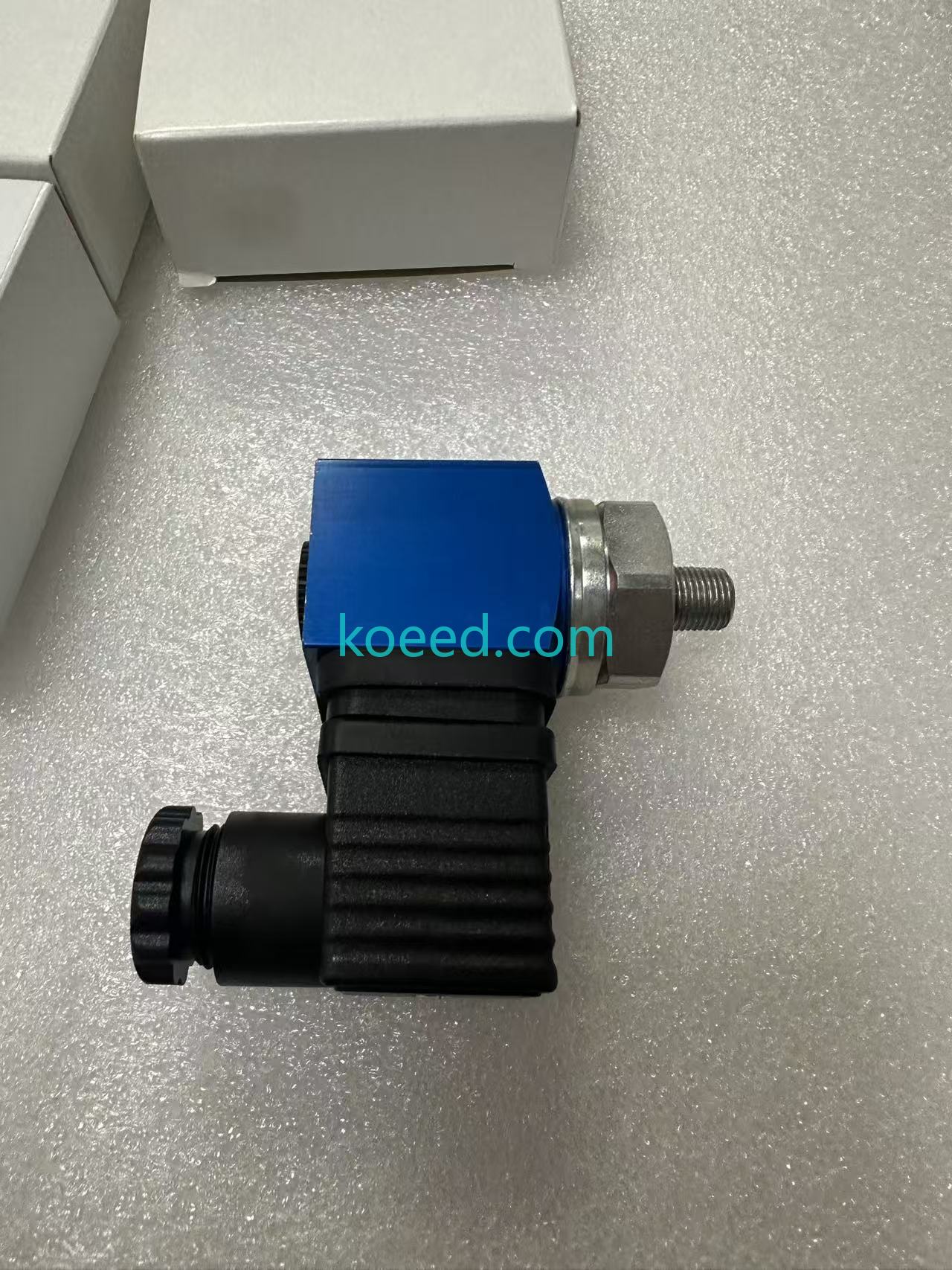
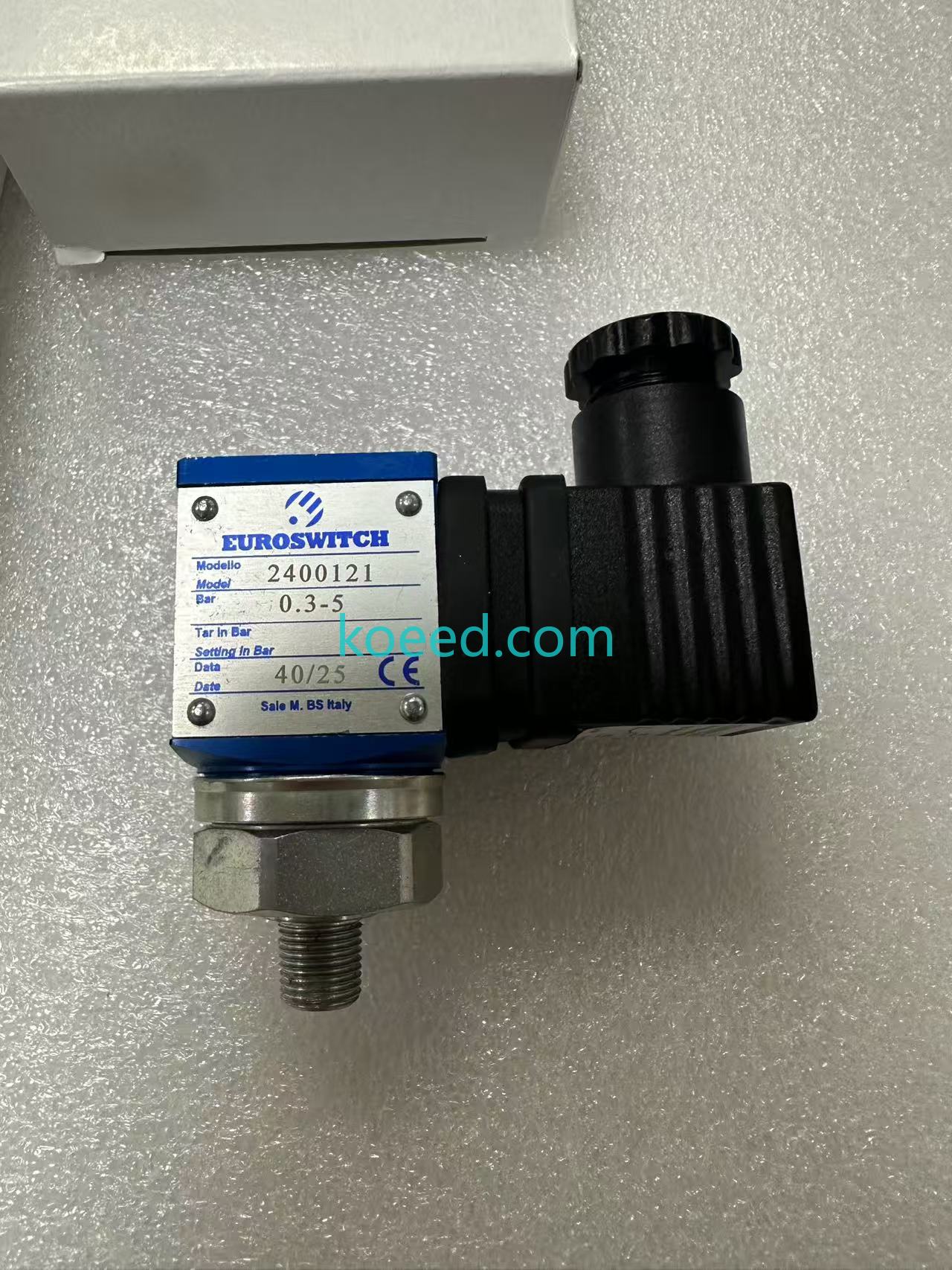
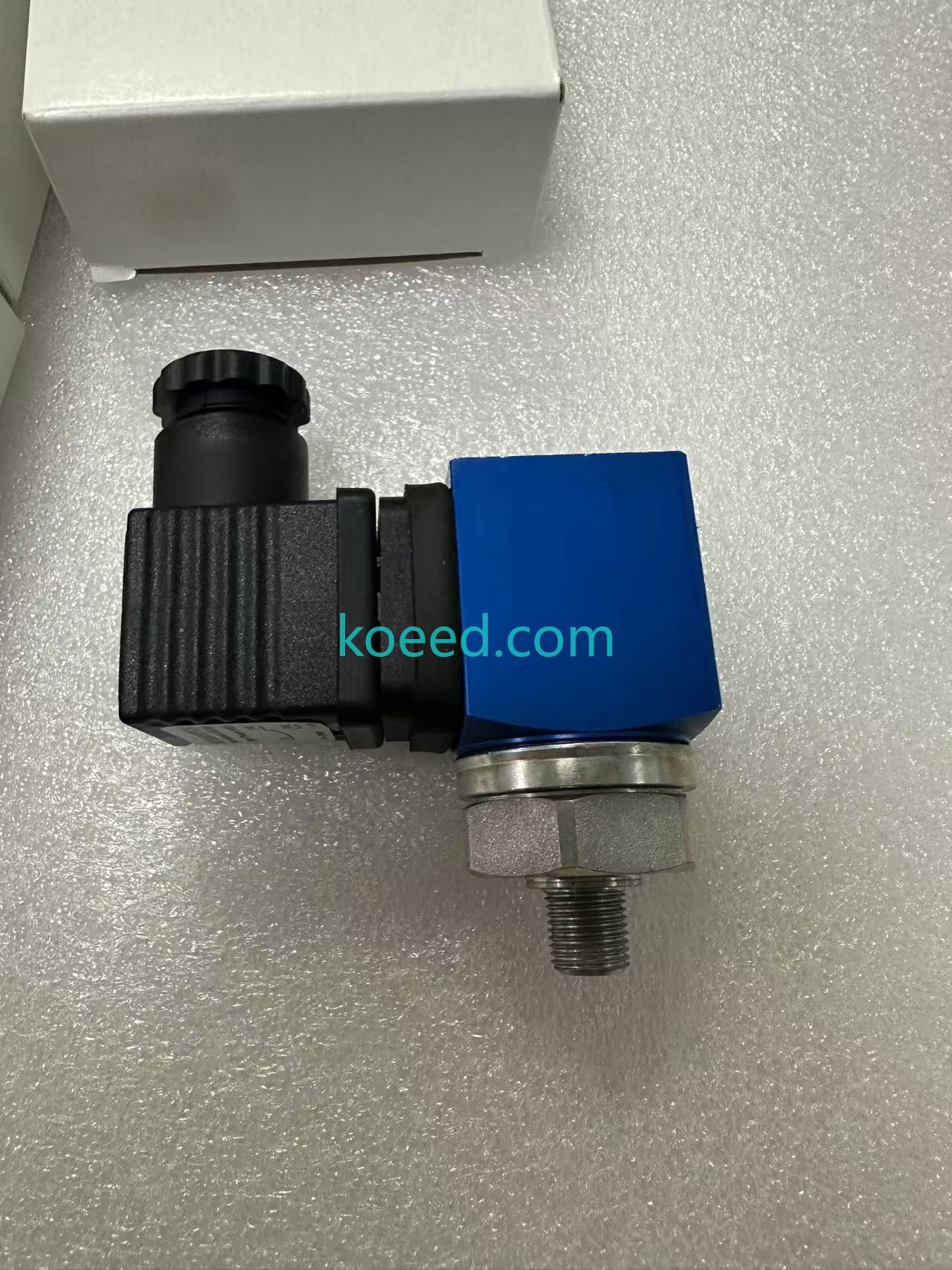
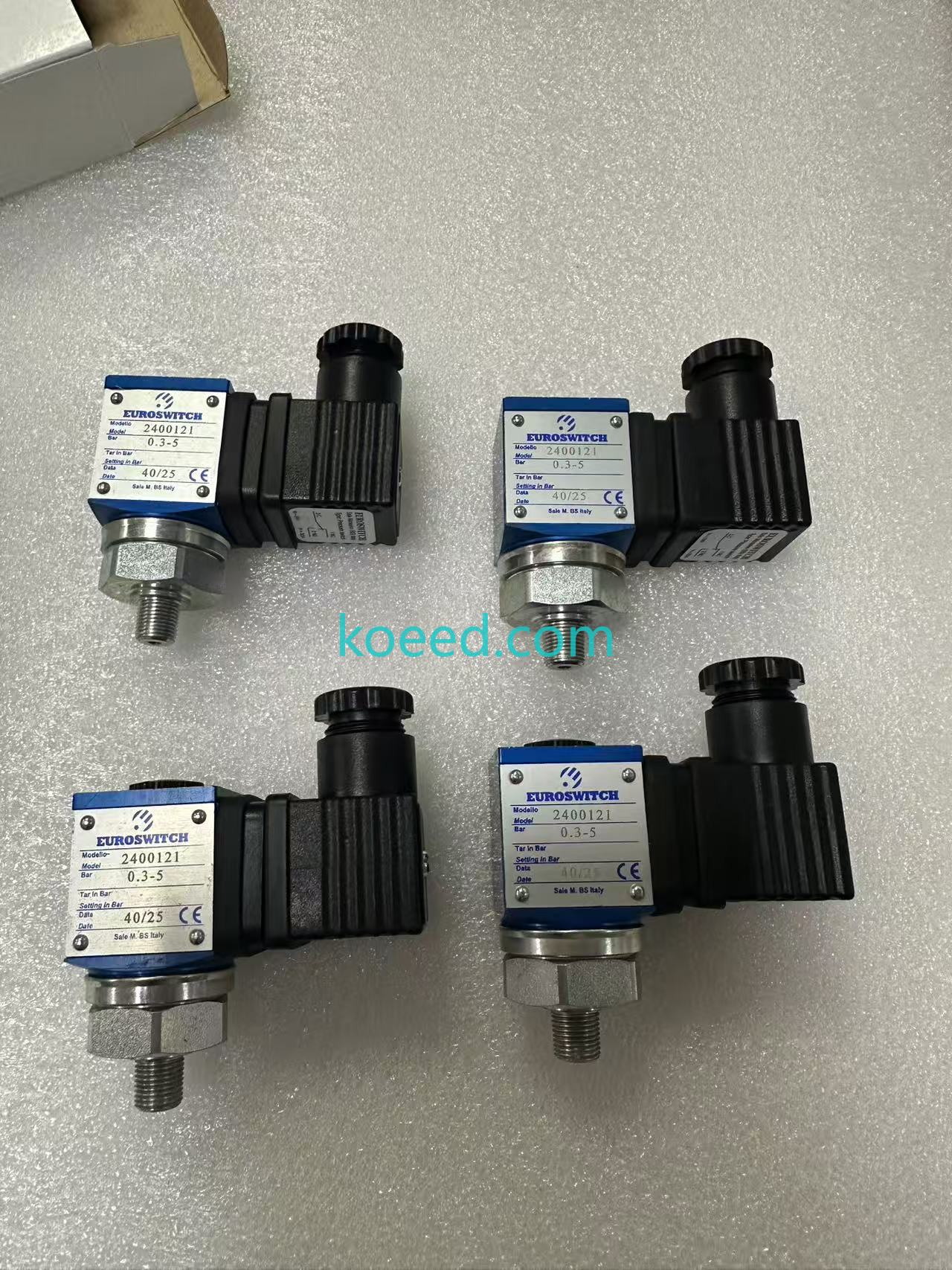
3. Visual Gallery: Euroswitch 2400121 Product Inspection
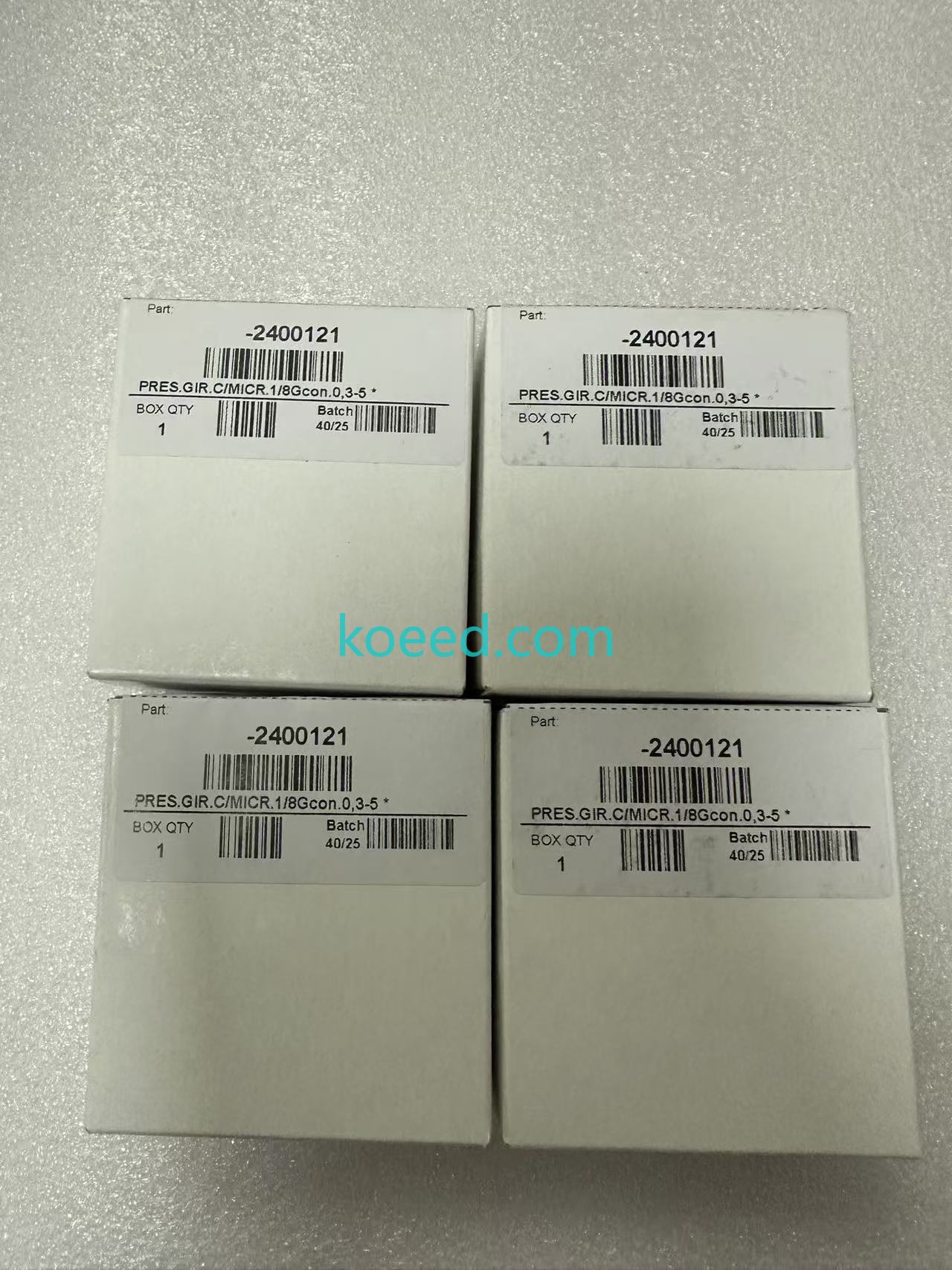
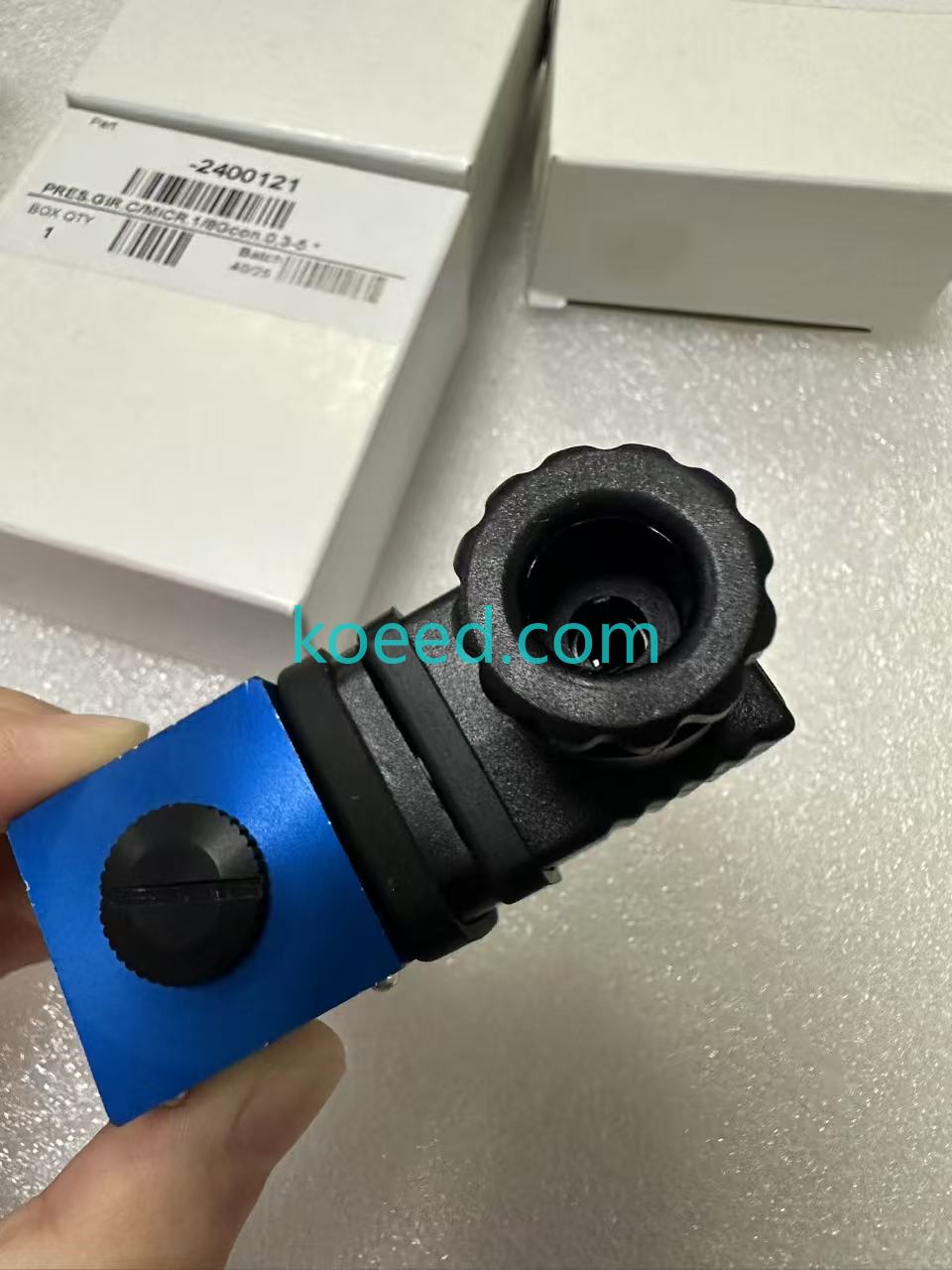
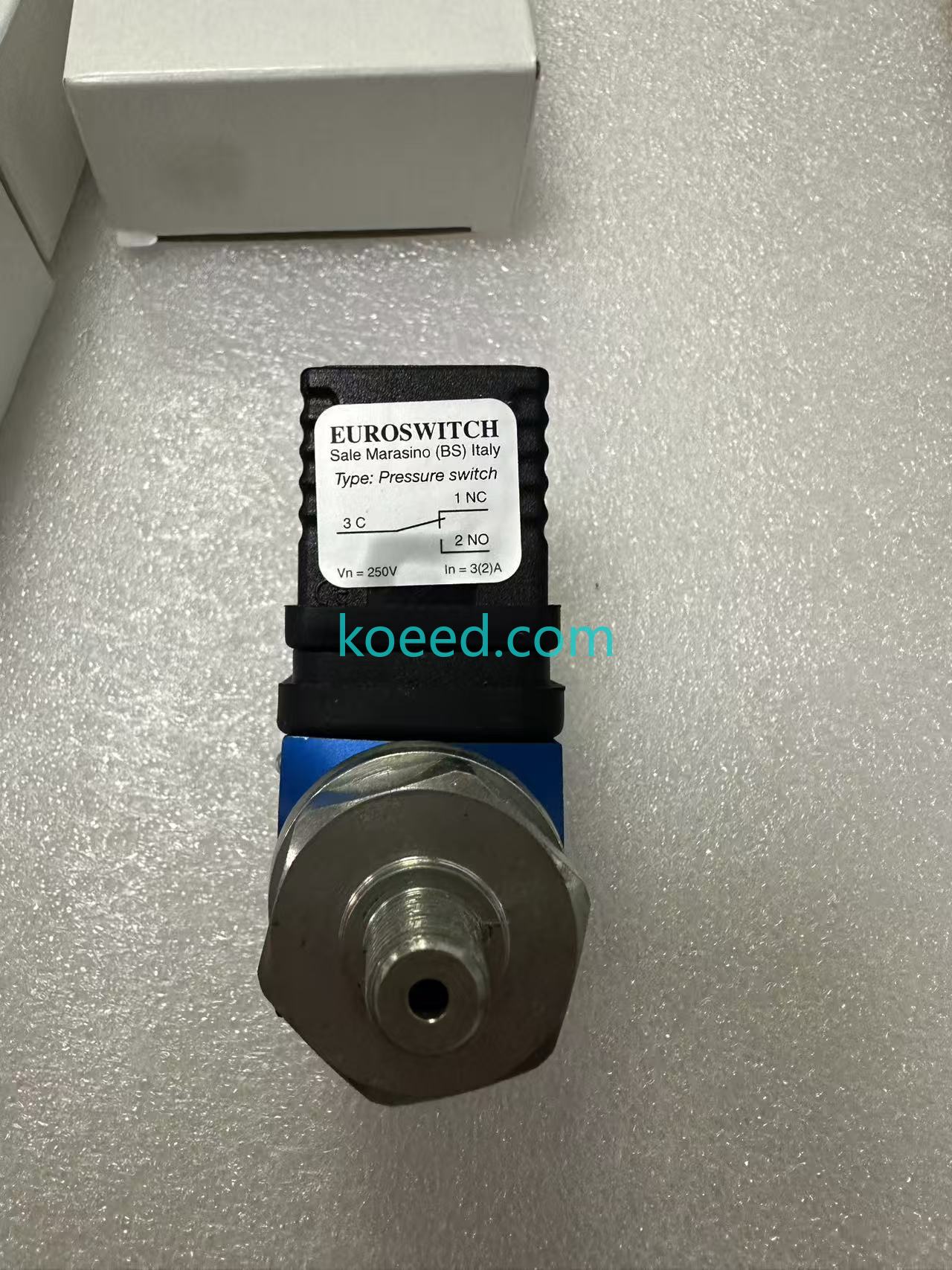
Below is a detailed visual inspection of the Euroswitch 2400121 Pressure Switch. These images confirm the build quality, DIN connector interface, G1/4 threaded process port, adjustment mechanism, and OEM packaging — all critical verification points for incoming quality control (IQC) teams.
4. IT/OT Convergence: Integrating the 2400121 into Smart Factory Architectures
The 2026 factory floor is no longer a collection of isolated control loops. Every binary sensor — including pressure switches — now participates in a layered data ecosystem stretching from the field level to the boardroom dashboard. Here is how the Euroswitch 2400121 fits into this convergence model.
4.1 PLC-Level Integration
The SPDT volt-free contact of the 2400121 connects directly to any standard PLC digital input module (24 VDC sinking/sourcing). When the sensed pressure crosses the user-adjusted setpoint, the contact changes state. This single bit of information triggers:
- Protective Interlocks: Pump shutdown on low suction pressure or filter blockage detection on high differential pressure.
- Sequencing Logic: Enabling the next stage in a multi-compressor cascade only when upstream pressure is confirmed.
- Alarm Escalation: Latching a fault bit in the PLC that propagates through the HMI, SCADA, and ultimately to CMMS (Computerized Maintenance Management System) work-order generation.
4.2 Edge-to-Cloud Telemetry
While the 2400121 itself outputs a simple contact closure, its signal gains exponential value when aggregated through edge computing nodes (such as Advantech UNO-series or Siemens IOT2050 gateways). Edge platforms timestamp each state transition, calculate switching frequency (an indicator of system instability), and push these derived KPIs to cloud platforms — AWS IoT SiteWise, Microsoft Azure IoT Hub, or Ignition Cloud Edition — for fleet-wide analytics.
4.3 OPC UA Wrapper Architecture
In brownfield facilities undergoing digital transformation, the 2400121's binary signal can be semantically enriched through an OPC UA wrapper running on the PLC or edge gateway. This converts the raw contact state into a structured data node — for example, ns=2;s=PressureSwitch_LubeOil_Min_OK — complete with metadata tags for asset registry, calibration date, and maintenance history. This approach satisfies the IEC 62541 OPC UA companion specification for industrial automation without replacing proven electromechanical hardware.
5. Maintenance, Troubleshooting & Longevity Protocols
Even the most robust pressure switch degrades without proper lifecycle management. The following protocols apply specifically to the Euroswitch 2400121 in 2026's predictive-maintenance-oriented operating culture.
5.1 Common Failure Modes & Diagnostic Matrix
| Symptom | Probable Cause | Corrective Action |
|---|---|---|
| Switch fails to change state at expected pressure | Setpoint drift due to vibration or thermal cycling | Recalibrate setpoint using a certified reference gauge; verify lock-nut torque |
| Intermittent contact chatter | Pressure pulsation near the switching threshold | Install a snubber/orifice fitting at the process port; increase hysteresis if adjustable |
| Contact welding / failure to open | Inductive load switching without arc suppression | Add flyback diode (DC) or RC snubber (AC) across the load; verify contact rating not exceeded |
| Fluid ingress at electrical connector | Degraded DIN connector gasket or improper IP alignment | Replace DIN connector gasket; verify IP65 mating; apply dielectric grease to terminals |
| Slow response to pressure changes | Clogged process port orifice | Remove switch, clean port with compatible solvent, inspect for debris; consider inline Y-strainer upstream |
5.2 Predictive Maintenance Integration
In a 2026 smart-factory context, the 2400121's switching events become a data stream. Track the following derived metrics in your CMMS:
- Cycle Count Accumulation: Each state transition increments a counter in the PLC. When the count approaches 800,000 (80% of rated life), trigger a planned replacement work order — before failure occurs.
- Dwell-Time Ratio: Monitor the ratio of time spent in the "pressure OK" vs. "pressure low" state. A gradual shift in this ratio reveals system-level degradation (e.g., increasing compressor blow-by, slow filter clogging).
- Switching Frequency Trend: An increasing switching frequency over a 7-day rolling window indicates an unstable pressure regulation loop — potentially caused by a failing relief valve, PID tuning drift, or accumulator pre-charge loss.
6. ROI, TCO & Sustainability Analysis
Procurement decisions in 2026 are evaluated across three axes: Total Cost of Ownership (TCO), Operational Resilience ROI, and Sustainability Impact. Below is the business case for the Euroswitch 2400121.
6.1 TCO Breakdown (5-Year Horizon, Single Unit)
| Cost Category | Euroswitch 2400121 | Electronic Transmitter Equivalent |
|---|---|---|
| Initial Hardware Cost | ~€35–€65 | ~€180–€350 |
| Installation Labor (0.5 hr) | ~€25 | ~€35 (additional wiring) |
| PLC I/O Cost Allocation | DI point: ~€8 | AI point: ~€45 |
| 5-Year Energy Cost | €0 (passive device) | ~€12 (loop power @ 4 mA, 24 VDC) |
| Calibration Cost (×5 annual) | ~€75 (simple gauge verification) | ~€250 (requires calibrated source + multimeter) |
| Replacement Parts (Year 4–5) | €0 (lifecycle ≥ 10 years typical) | ~€60 (sensor element drift risk) |
| 5-Year TCO Estimate | ~€133–€173 | ~€582–€752 |
6.2 Sustainability & Energy Impact
The Euroswitch 2400121 contributes to corporate sustainability KPIs in three measurable ways:
- Zero Parasitic Power Draw: As a passive electromechanical device, the 2400121 consumes no continuous electrical power. In a facility with 200+ monitoring points, choosing passive switches over loop-powered transmitters saves approximately 840 kWh annually — equivalent to ~370 kg CO₂e at the average 2026 EU grid carbon intensity.
- Leakage Prevention: Fast-acting pressure-switch interlocks that immediately shut down pumps or isolate leaking circuits prevent compressed air and hydraulic fluid loss. A single undetected 2-mm compressed-air leak costs approximately €1,200/year in energy; the 2400121's rapid response eliminates this waste stream.
- Material Efficiency: With a mechanical lifespan exceeding 1 million cycles, the 2400121's embodied carbon per switching event is orders of magnitude lower than electronic alternatives that face obsolescence within 5–7 years due to semiconductor lifecycle management and firmware deprecation.
7. Frequently Asked Questions
What is the adjustable pressure range of the Euroswitch 2400121?
The Euroswitch 2400121 offers a field-adjustable setpoint within the range of 0.3 bar (minimum) to 5 bar (maximum). This makes it versatile for low-pressure hydraulic and pneumatic circuits.
Is the Euroswitch 2400121 suitable for safety-critical applications?
Yes, provided it is installed according to relevant safety standards and calibrated regularly. Its SPDT contact allows redundant wiring to a safety PLC. Always consult local regulations (e.g., EN ISO 13849-1) for PLr/SIL requirements.
Can I use this switch with air, water, and hydraulic oil?
The wetted materials (typically brass and NBR/FKM seals) are compatible with mineral oils, water-glycol, and compressed air. Verify chemical compatibility with specific fluids if using aggressive media. For oxygen or food-grade applications, contact the supplier.
How do I connect the Euroswitch 2400121 to a PLC?
Wire the common (COM), normally open (NO), and normally closed (NC) terminals to a PLC digital input module. The switch is passive, so you’ll need a 24V DC supply loop. Refer to the wiring diagram on the product label.
Ready to Deploy the Euroswitch 2400121 in Your Facility?
Contact KOEED today for volume pricing, technical datasheets, and integration support.


