

MC68030RP33B in 2026: The 32-Bit Legacy Powerhouse Powering Industrial Retrofit & Critical Infrastructure
1. Strategic Overview: Why the MC68030RP33B Matters in 2026
In an era dominated by ARM Cortex-A and x86_64 edge computing, it may seem surprising that a 32-bit CISC microprocessor first introduced in 1987 still commands attention on factory floors and in mission-critical embedded systems. Yet the Motorola MC68030RP33B — clocked at 33 MHz in a ceramic PGA (Pin Grid Array) package — remains a cornerstone of industrial longevity strategies in 2026.
The 2026 industrial automation landscape is defined by retrofitting, not replacement. According to industry surveys, over 62% of manufacturing plants worldwide still operate machinery built around the Motorola 68000 family. These are not obsolete relics — they are stable, deterministic controllers running CNC systems, VMEbus-based process controllers, telecom switching equipment, and aerospace guidance subsystems. The MC68030RP33B, with its integrated MMU and burst-mode memory interface, is often the exact drop-in replacement needed to sustain these systems for another decade.
At Koeed, we specialize in sourcing authenticated, tested MC68030RP33B units for industrial clients worldwide. Whether you are managing a VMEbus backplane in a steel mill or maintaining a legacy avionics test bench, this processor is your lifeline to system continuity.
2. IT/OT Convergence: Bridging Legacy 68K Systems to the Cloud
One of the most significant challenges in 2026 industrial automation is IT/OT convergence — connecting operational technology (OT) assets to modern IT infrastructure for real-time analytics, MES integration, and ERP visibility. Legacy systems driven by the MC68030RP33B can be successfully integrated into Industry 4.0 frameworks through several proven architectural patterns:
2.1 Edge Gateway Bridging
Deploy an edge gateway (e.g., an ARM-based Linux SBC) that communicates with the 68K-based controller via legacy serial protocols (RS-232/RS-485) or shared memory over VMEbus, then translates data into MQTT/OPC UA for cloud ingestion. The MC68030RP33B's dual on-chip caching (256-byte instruction + 256-byte data) ensures the real-time control loop is never compromised by the upstream bridge.
2.2 Retrofit Sensor Overlay
For brownfield deployments, overlay IIoT sensor modules that monitor vibration, temperature, and current draw — feeding predictive maintenance dashboards without touching the trusted MC68030 control path. This approach preserves the deterministic execution that the 68030's Harvard-style cache architecture is renowned for.
3. Technical Benchmarking: MC68030RP33B vs. Modern Alternatives
Understanding where the MC68030RP33B fits requires a clear-eyed assessment of its specifications against both legacy contemporaries and modern replacement considerations.
| Parameter | MC68030RP33B | MC68020 (Predecessor) | MC68040 (Successor) | Modern ARM Cortex-M7 |
|---|---|---|---|---|
| Architecture | 32-bit CISC | 32-bit CISC | 32-bit CISC + FPU | 32-bit RISC (ARMv7-M) |
| Clock Speed | 33 MHz | 16–25 MHz | 25–40 MHz | Up to 600 MHz |
| MMU | Integrated (on-chip) | External (MC68851) | Integrated (dual) | MPU only (no MMU) |
| L1 Cache | 256B I + 256B D | 256B I (MC68EC020) | 4KB I + 4KB D | Up to 64KB (unified) |
| Package | 128-pin PGA (CERAMIC) | 114-pin PGA | 179-pin PGA | LQFP / BGA |
| Address Bus | 32-bit (4 GB addressable) | 32-bit | 32-bit | 32-bit (limited by MPU) |
| Bus Protocol | Asynchronous + Burst | Asynchronous | Burst + Split | AHB / AXI |
| Supply Voltage | 5V ±5% | 5V | 5V | 1.8V–3.3V |
| Pin Compatibility | Drop-in for MC68020 PGA | — | Largely compatible | No direct compatibility |
The key takeaway: the MC68030RP33B's on-chip MMU and burst-mode memory interface made it a generational leap over the 68020, while its simpler pipeline and lower power dissipation give it an edge over the 68040 in thermally constrained industrial enclosures. No modern ARM microcontroller offers true drop-in VMEbus compatibility — making the MC68030RP33B irreplaceable for in-situ repairs.
4. Visual Inspection Gallery
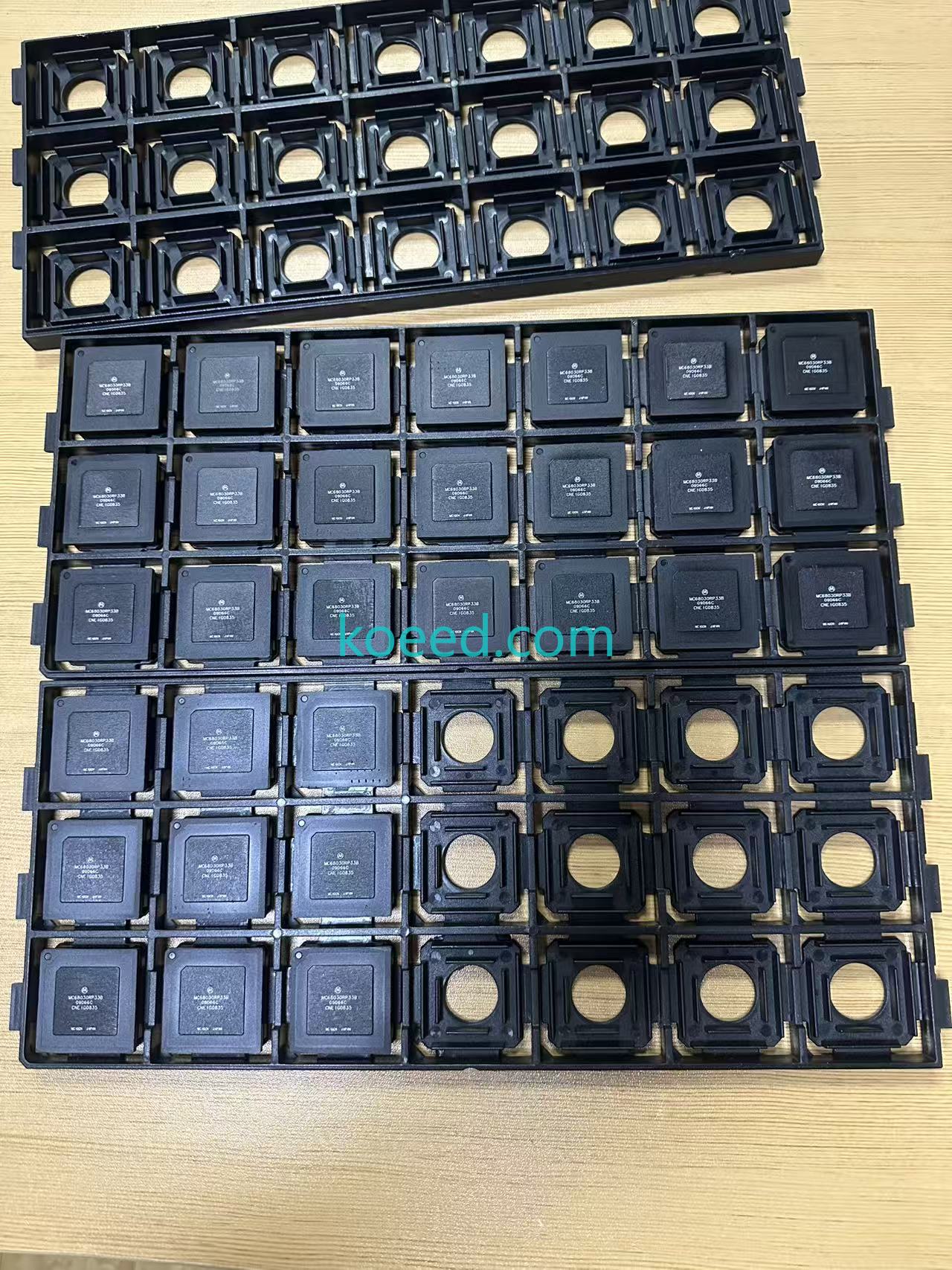
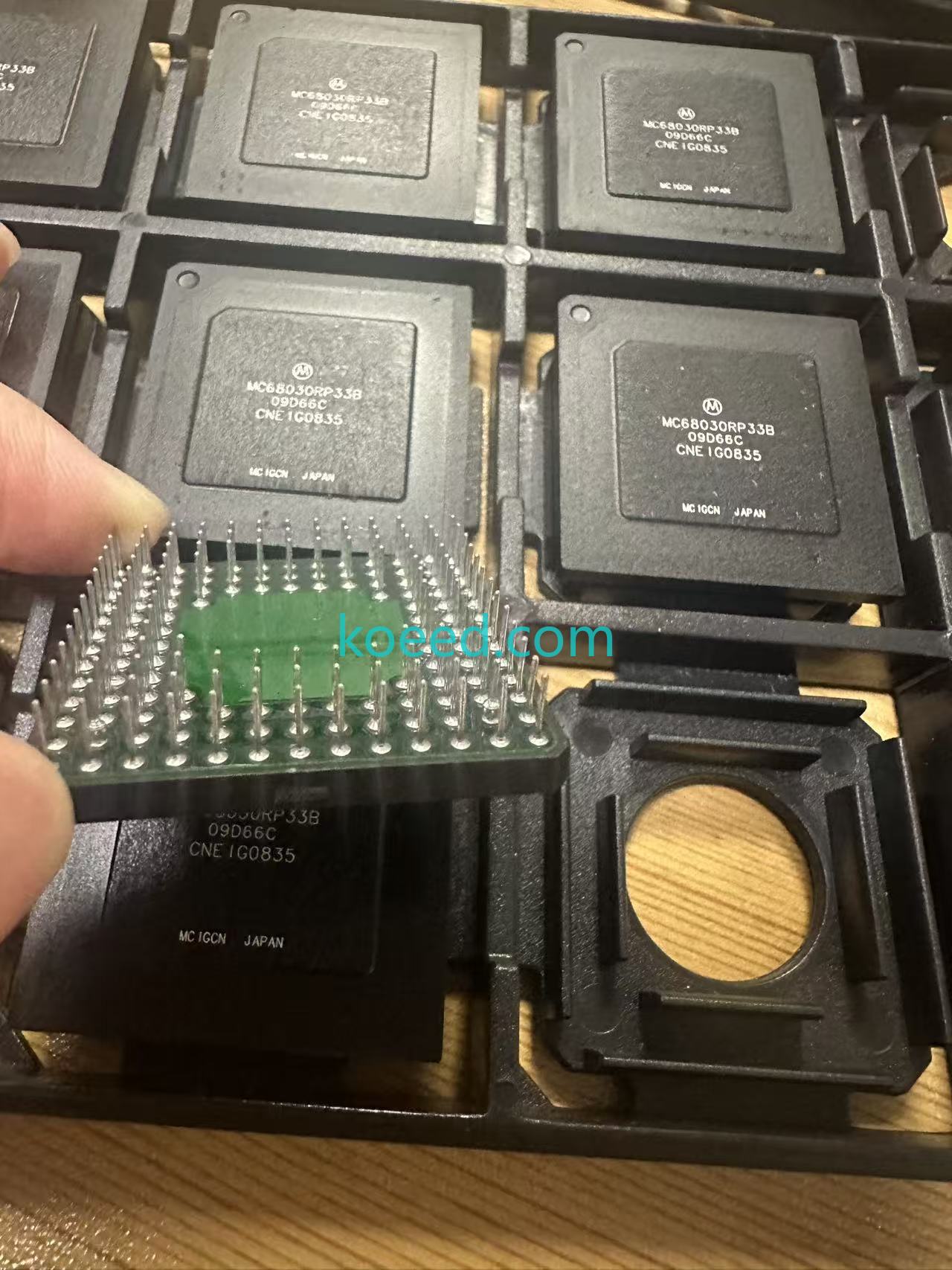
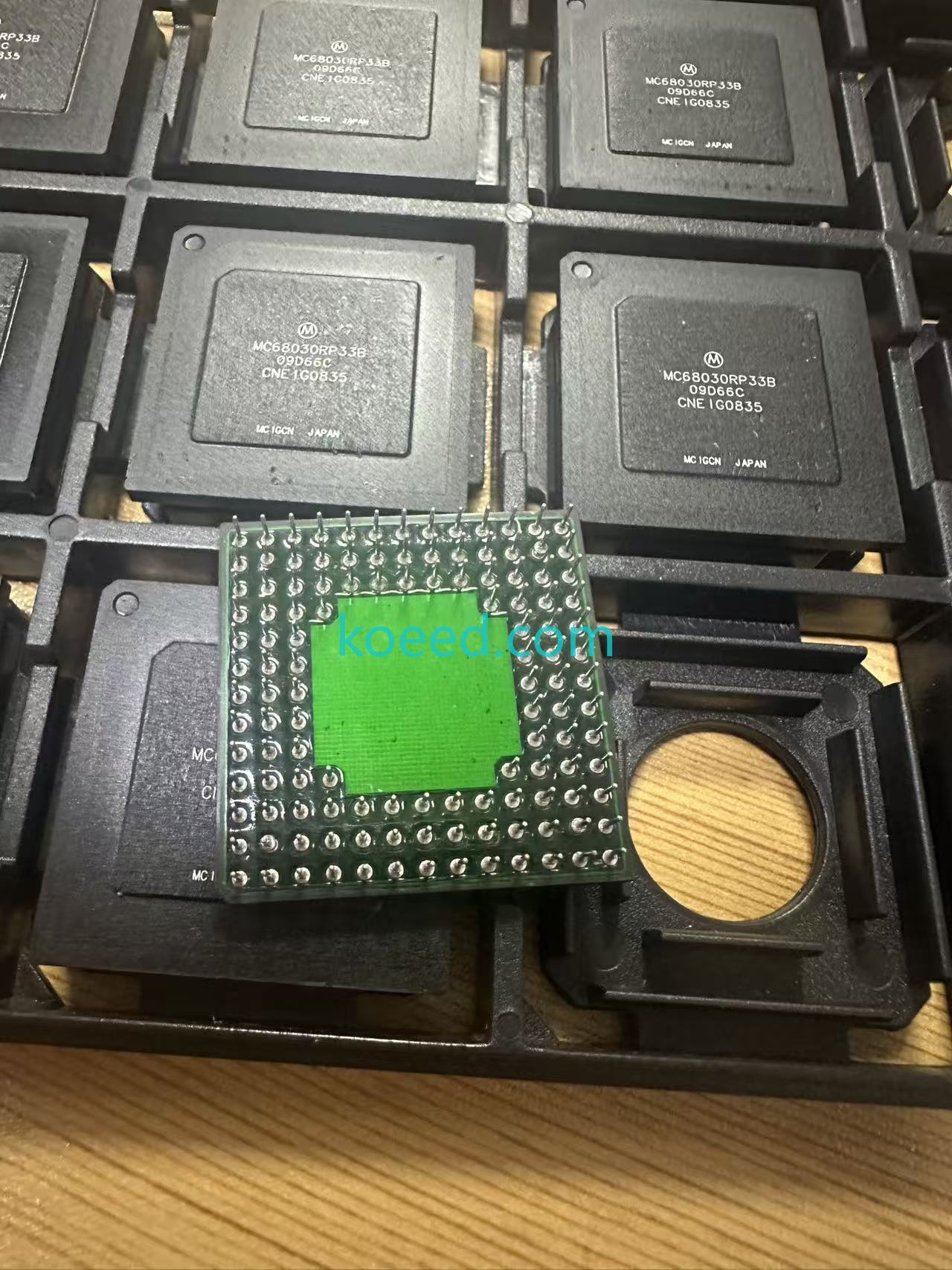
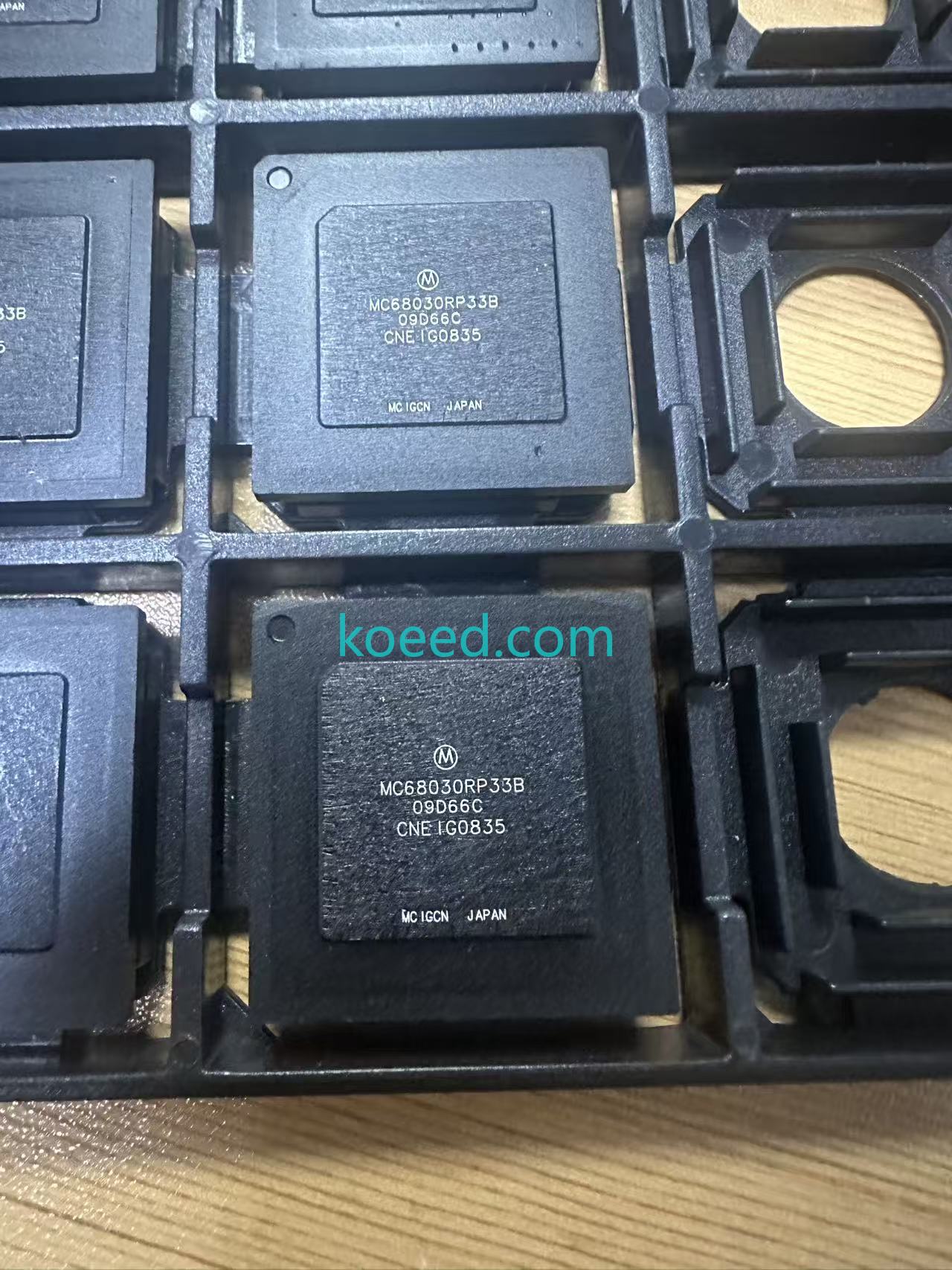
Below is the actual product imagery for the MC68030RP33B stock at Koeed. These high-resolution photographs assist procurement engineers in verifying package marking, pin integrity, and ceramic PGA condition prior to purchase.
5. ROI & Total Cost of Ownership (TCO) Analysis
When evaluating the MC68030RP33B for industrial maintenance, decision-makers must look beyond unit price to Total Cost of Ownership. A full controller replacement often costs 8–15× the price of a processor swap once you factor in:
5.1 Cost Comparison: Processor Swap vs. Full Retrofit
| Cost Factor | MC68030RP33B Drop-In Swap | Full Controller Replacement |
|---|---|---|
| Hardware Cost | $85–$250 (authentic tested unit) | $4,500–$25,000+ |
| Engineering Time | 2–4 hours (single technician) | 80–300+ hours (team) |
| Downtime | < 1 shift | 3–14 days |
| Software Revalidation | None required | Full IEC 61131-3 re-coding |
| Operator Retraining | Zero | 2–8 days |
| Spare Parts Inventory | 1–2 extra units (~$500 max) | New ecosystem of spares |
| Estimated 5-Year TCO | < $2,000 | $18,000–$65,000+ |
The mathematics are compelling: for facilities operating 10–50 legacy controllers, the TCO savings from maintaining MC68030-based systems can exceed $500,000 over five years compared to a rip-and-replace strategy.
5.2 Energy & Sustainability Angle
In 2026, sustainability metrics directly impact regulatory compliance and ESG scoring. The MC68030RP33B's modest 1.5–2.5W typical power dissipation (at 33 MHz) contrasts sharply with modern edge computers drawing 15–65W. Retaining a 68K-based system avoids e-waste from perfectly functional VMEbus backplanes, power supplies, and I/O modules — aligning with circular-economy principles now mandated under EU and North American industrial sustainability frameworks.
6. Predictive Maintenance & Lifecycle Extension
Moving beyond reactive repair to predictive maintenance is the 2026 gold standard. For MC68030RP33B-based systems, this means monitoring the health of the processor and its surrounding ecosystem before failure occurs.
6.1 Key Failure Indicators for the MC68030RP33B
- Intermittent Bus Errors (BERR# assertion): Often the first sign of pin contact degradation in PGA sockets. Thermal cycling over decades can cause micro-fractures at solder points.
- Cache Consistency Faults: If the on-chip cache begins returning stale data, it may indicate silicon aging. Run a cache-disable diagnostic (via the CACR register) to isolate the issue.
- Unexpected MMU Page Faults: The integrated MMU on the MC68030RP33B is robust, but voltage rail instability (5V ±5% tolerance) can cause transient translation errors.
- Clock Jitter Sensitivity: At 33 MHz, the processor requires a clean, stable clock source. Degraded crystal oscillators on aging VMEbus CPU boards are a common root cause of sporadic failures.
6.2 Common Error Codes & Troubleshooting
| Symptom | Likely Cause | Resolution |
|---|---|---|
| System fails POST; black screen | MC68030 not seated or dead | Re-seat processor; swap with known-good unit from Koeed stock |
| Bus Error (BERR#) during heavy DMA | PGA pin oxidation on address lines A0–A31 | Clean pins; replace socket if corroded |
| MMU translation fault (vector 8) | Corrupted MMU root pointer or 5V rail noise | Verify PSU ripple < 50mV; reload MMU tables |
| Cache parity / consistency error | Aging on-chip SRAM cells | Disable cache via CACR; if stable, replace processor |
| Intermittent lock-up above 40°C ambient | Ceramic package thermal stress | Improve enclosure airflow; verify heatsink contact |
7. Sourcing Authentic MC68030RP33B in 2026: Avoiding Counterfeit Risks
The vintage semiconductor market is unfortunately rife with counterfeit, remarked, and blacktopped components. In 2026, procurement engineers must exercise heightened diligence when sourcing 68K-family processors. Koeed's MC68030RP33B inventory undergoes a rigorous five-point authentication protocol:
- Laser Marking Verification: Genuine Motorola MC68030RP33B units feature a distinct font with specific kerning on the ceramic lid. The Koeed gallery above shows the authentic marking profile.
- Pin Grid Alignment Check: All 128 pins are inspected under 20× magnification for straightness, gold-plating uniformity, and absence of re-tinning.
- Electrical Test @ 33 MHz: Each unit is socketed into a validated VMEbus test jig and exercised under full bus load for a minimum of 4 hours.
- MMU & Cache Diagnostic: Proprietary test firmware validates every MMU page table entry and both instruction and data cache lines.
- Thermal Imaging Pass: Infrared thermography at full load confirms uniform die temperature distribution — a hallmark of an authentic, undamaged Motorola die.
8. Frequently Asked Questions
Is the MC68030RP33B still in production in 2026?
No. Motorola (now NXP) discontinued the MC68030 family decades ago. All units available on the market — including Koeed's stock — are new old stock (NOS) or carefully harvested from decommissioned equipment. Koeed only supplies units that pass our full electrical and cosmetic authentication protocol described above. For verified NOS inventory, visit our MC68030RP33B product page.
Can the MC68030RP33B directly replace an MC68020 in my VMEbus CPU board?
Yes — in most cases. The MC68030 was designed with a high degree of pin-compatibility with the MC68020 in PGA packages. However, verify that your board's firmware accounts for the 68030's on-chip MMU (the 68020 required an external MC68851). Some boards may require a jumper configuration change to select internal vs. external MMU sourcing. Consult your board's technical reference manual before performing the swap.
What is the expected remaining service life of an NOS MC68030RP33B?
When stored in humidity-controlled, ESD-safe conditions (as Koeed maintains), ceramic PGA-packaged microprocessors have an effectively indefinite shelf life. The primary aging mechanisms — electromigration and hot-carrier injection — only occur under active operation. A properly stored NOS MC68030RP33B can be expected to deliver 15–25+ years of continuous service at typical industrial operating conditions (25–50°C, 5V regulated).
Does the MC68030RP33B support any real-time operating systems?
Absolutely. The MC68030, with its integrated MMU and supervisor/user mode architecture, was a premier target for RTOS platforms including VxWorks (Wind River), pSOS+, OS-9 (Microware), and RTEMS. Many 2026 industrial deployments continue running these mature, battle-hardened RTOS platforms. The processor's deterministic interrupt latency (typically under 2 µs at 33 MHz) rivals many modern embedded cores.
How do I integrate an MC68030-based system with a modern SCADA platform?
The most reliable approach is a protocol gateway: a small Linux-based edge device that speaks the legacy protocol on one side (Modbus RTU over serial, Bitbus, or raw VMEbus shared memory access) and MQTT/OPC UA on the other. The MC68030RP33B continues executing its real-time control loop with zero software changes, while the gateway handles all IT-side communication. Koeed can recommend integration partners upon request.
9. Final CTA: Secure Your MC68030RP33B Supply Chain
In 2026, the supply of authenticated, tested MC68030 processors grows scarcer each quarter. Downtime from a failed legacy controller can cost $8,000–$50,000 per hour in continuous-process industries. Procuring a spare MC68030RP33B today is not a purchase — it is insurance against catastrophic production loss.
Ready to Secure Your Legacy Infrastructure?
Speak with a Koeed industrial automation specialist today. We provide volume pricing, express global shipping, and technical compatibility verification for your exact board revision.


