

CNC Lathe Operating Membrane Key Sheet Overlay: The 2026 HMI Standard for Smart Machining | Koeed
Strategic Overview: Why the Membrane Key Sheet Overlay Defines HMI Reliability in 2026
In the 2026 industrial automation landscape — where the global market has surged past $261 billion and smart factories demand seamless IT/OT convergence — the humble CNC Lathe Operating Membrane Key Sheet Overlay has quietly become a mission-critical interface component. It is the tactile bridge between skilled operators and the data-rich digital twins running on cloud-connected CNC controllers.
Unlike legacy rigid keyboards or consumer-grade touchscreens, the industrial membrane key sheet overlay delivers contaminant resistance, haptic precision, and field-serviceable longevity — precisely the attributes that 2026 predictive maintenance frameworks demand from every node in the production chain. With unplanned downtime costing manufacturers an average of $260,000 per hour in high-mix CNC environments (2026 KGT Solutions benchmark), the reliability of the operator interface is no longer a marginal concern — it is a KPI.
Technical Benchmarking: Membrane Key Overlay vs. Legacy Interfaces
Understanding where the modern CNC lathe membrane overlay fits within the 2026 HMI ecosystem requires direct comparison. Below, we benchmark this technology against competing interface solutions still found on shop floors:
| Parameter | Membrane Key Sheet Overlay (2026 Standard) | Mechanical Push-Button Panel | Capacitive Touchscreen | Legacy Silicone Rubber Pad |
|---|---|---|---|---|
| Ingress Protection (IP) | IP65–IP67 (fully sealed) | IP40–IP54 (gap ingress risk) | IP54–IP65 (glove-sensitivity loss) | IP55–IP65 (swell/degrade with coolant) |
| Actuation Lifecycle | 1M–5M cycles | 500K–2M cycles | Unlimited (but drift-prone) | 300K–1M cycles |
| Chemical Resistance | Excellent (polyester/polycarbonate top layer) | Moderate (corrosion on contacts) | Poor (screen etching from coolant mist) | Poor (silicone swelling) |
| Operator Glove Compatibility | Full tactile feedback with thick gloves | Full | Degraded (special conductive gloves needed) | Moderate |
| Predictive Maintenance Ready | ✅ Yes — resistance drift measurable | ⚠️ Limited — contact inspection only | ⚠️ Limited — calibration drift detectable | ❌ No — catastrophic failure mode |
| Retrofit Complexity | Low — adhesive-backed, plug-compatible | High — mechanical rework needed | High — controller firmware update required | Medium — adhesive replacement |
| Unit Cost (2026 USD, Industrial) | $45–$180 | $120–$400 | $350–$1,200 | $25–$90 |
2026 Context: IT/OT Convergence and the Smart Membrane Interface
In 2026, the membrane key overlay is no longer a passive component. Forward-thinking CNC integrators are embedding thin-film resistive sensors within overlay layers to feed usage telemetry into edge-computing nodes. This data — actuation count, force variance, resistance drift — flows directly into predictive maintenance algorithms hosted on platforms like Siemens MindSphere, Rockwell FactoryTalk, or open-source OPC-UA stacks.
Key Integration Pathways:
- Edge Gateways: Membrane key scan matrices connect via GPIO-to-Ethernet bridges, transmitting per-key actuation logs to MQTT brokers for real-time dashboarding.
- Digital Twin Syncing: Operator input patterns are mirrored into the CNC digital twin, enabling AI-based anomaly detection — e.g., flagging when an operator repeatedly re-presses the same key (indicating tactile degradation).
- Sustainability Reporting: Membrane overlays with 5M-cycle lifespans reduce e-waste by 40–60% compared to disposable silicone alternatives, contributing directly to Scope 3 emissions reduction targets.
Visual Gallery: CNC Lathe Operating Membrane Key Sheet Overlay
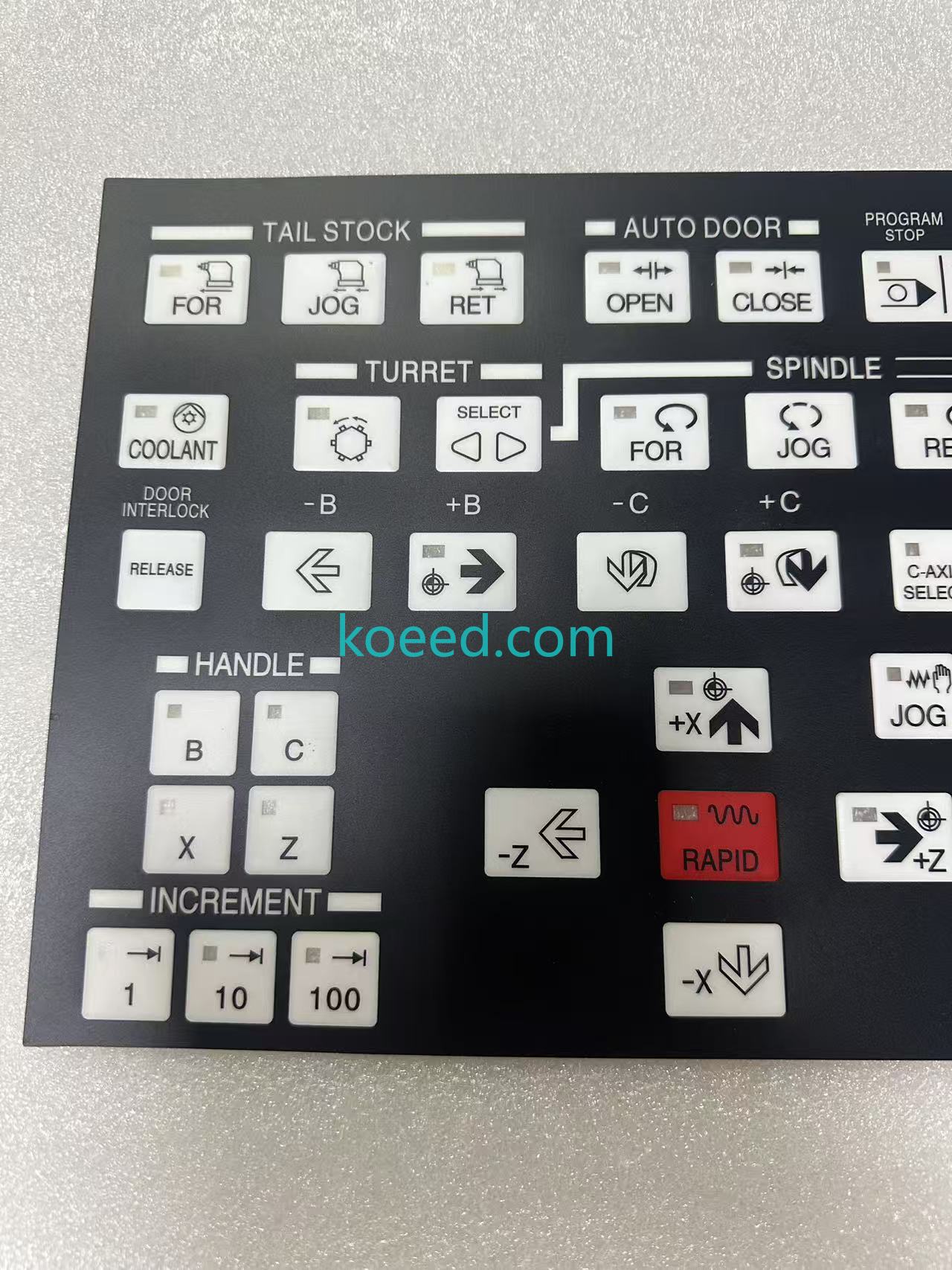
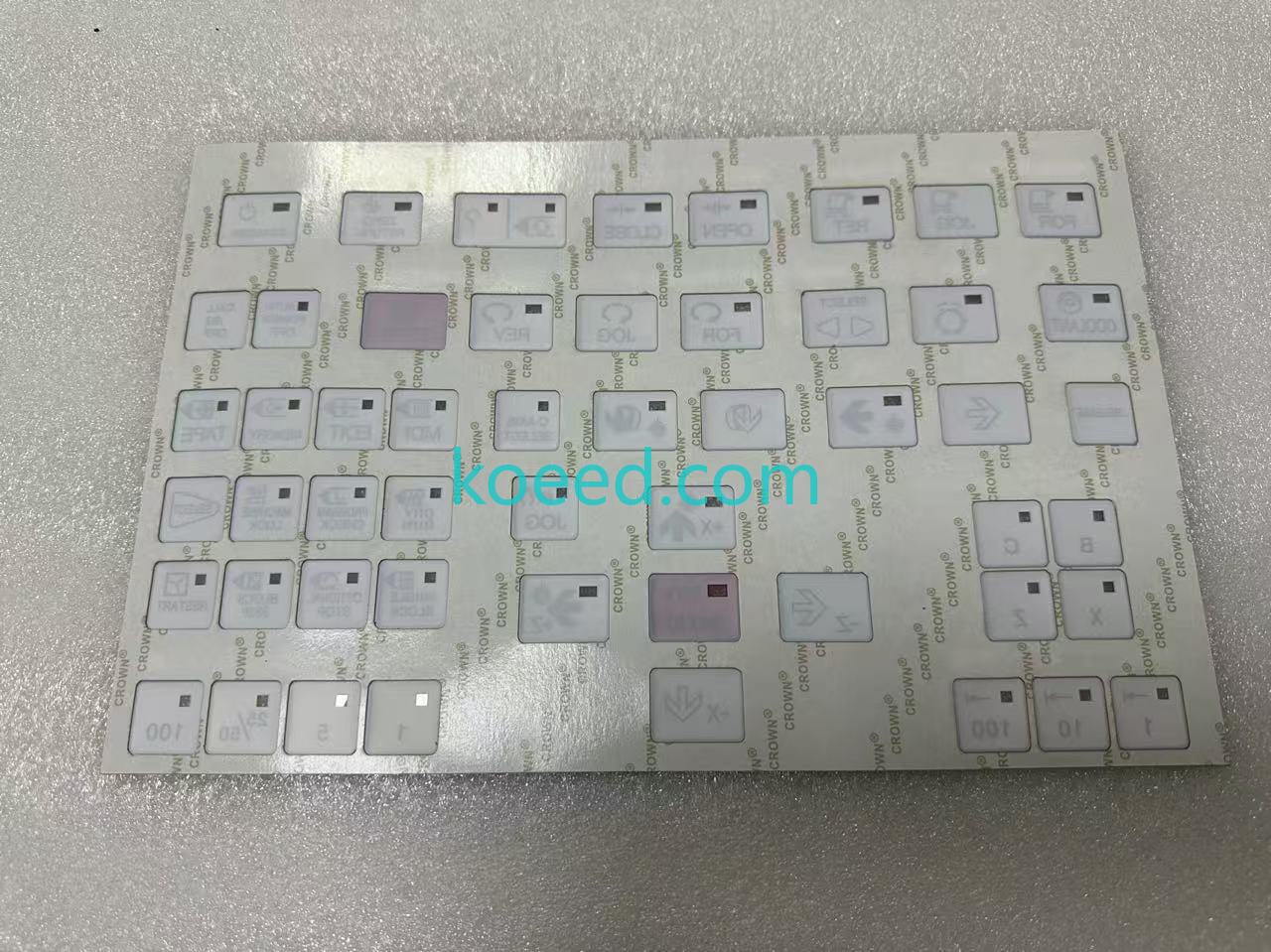
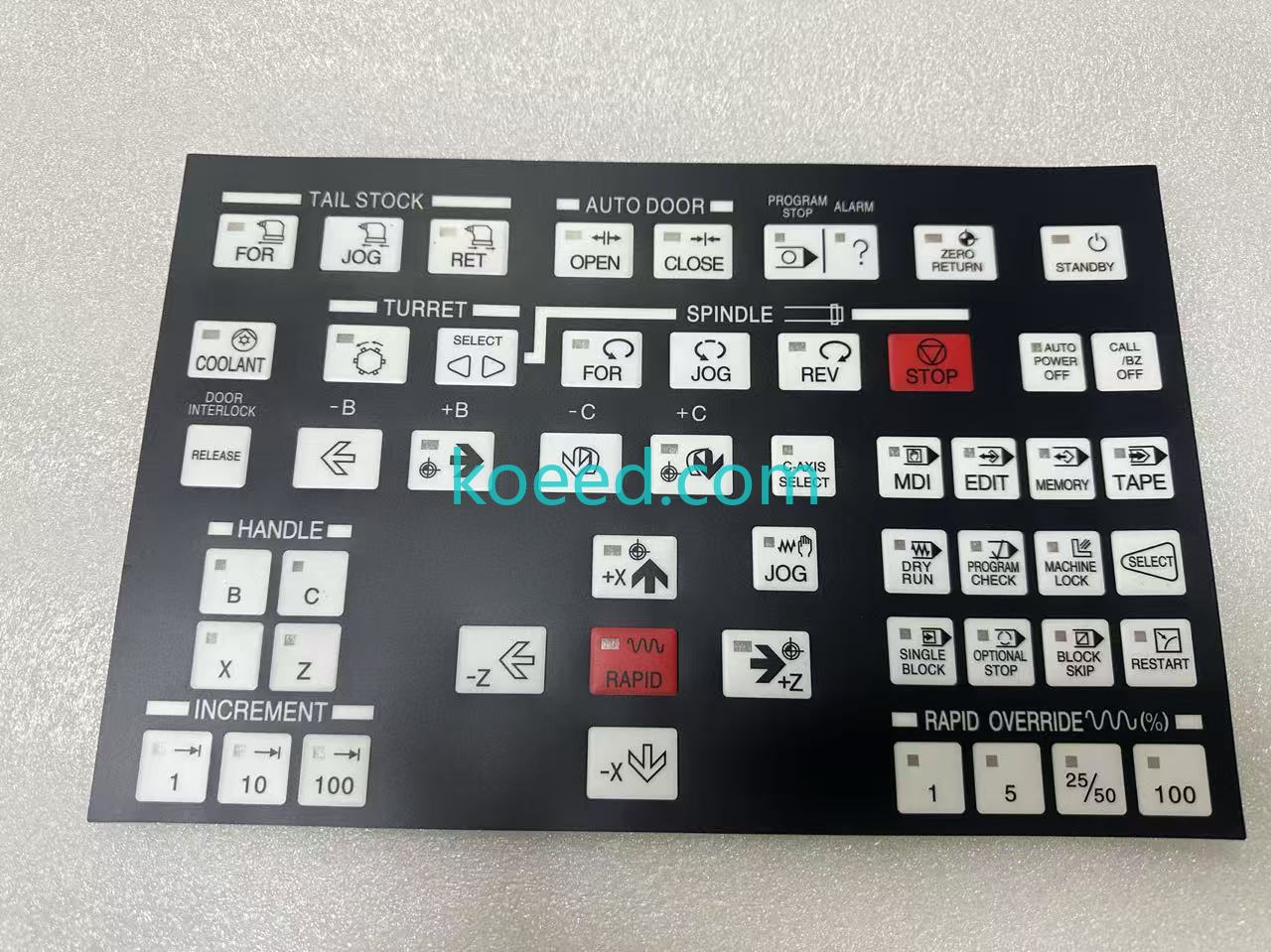
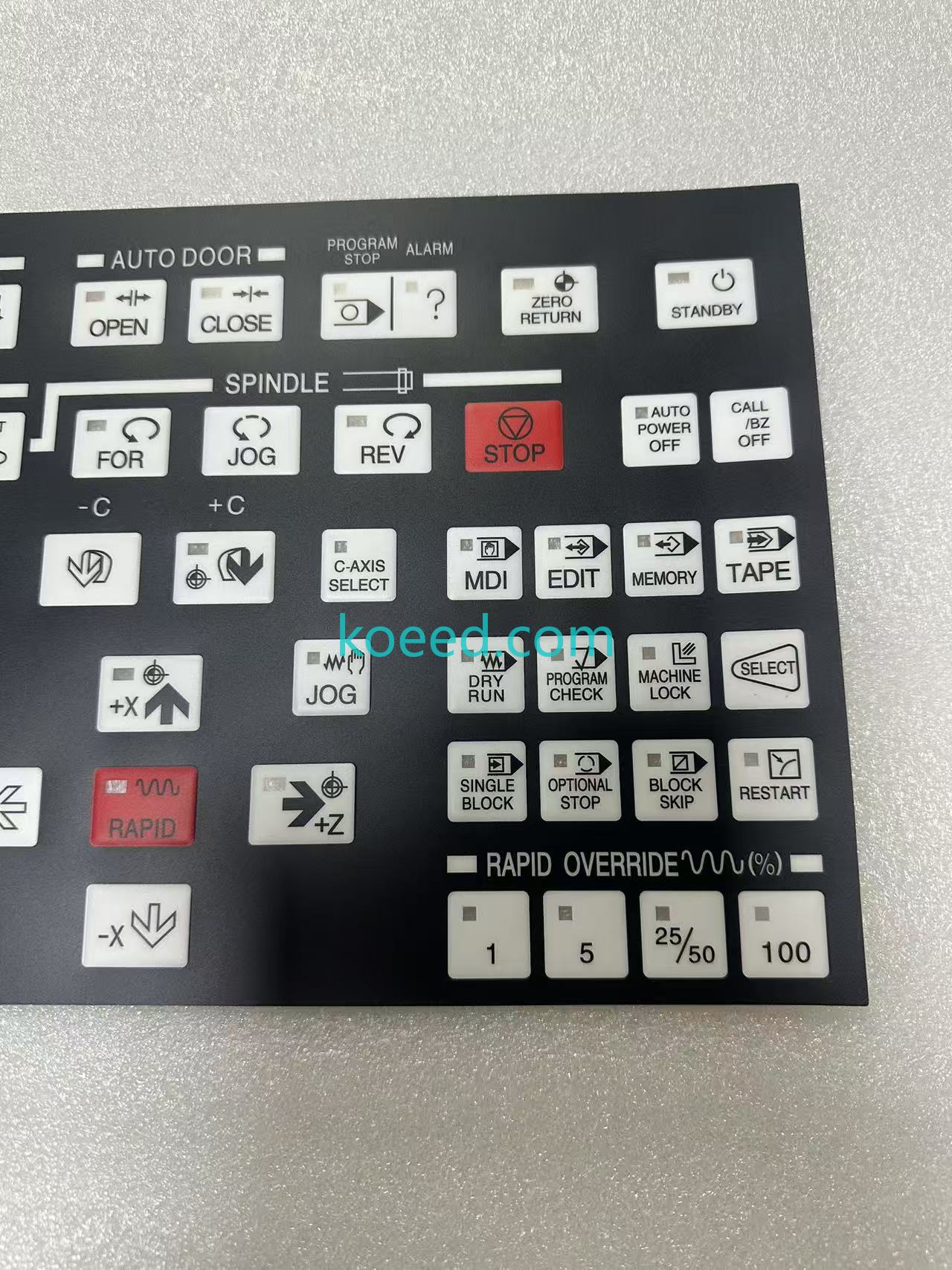
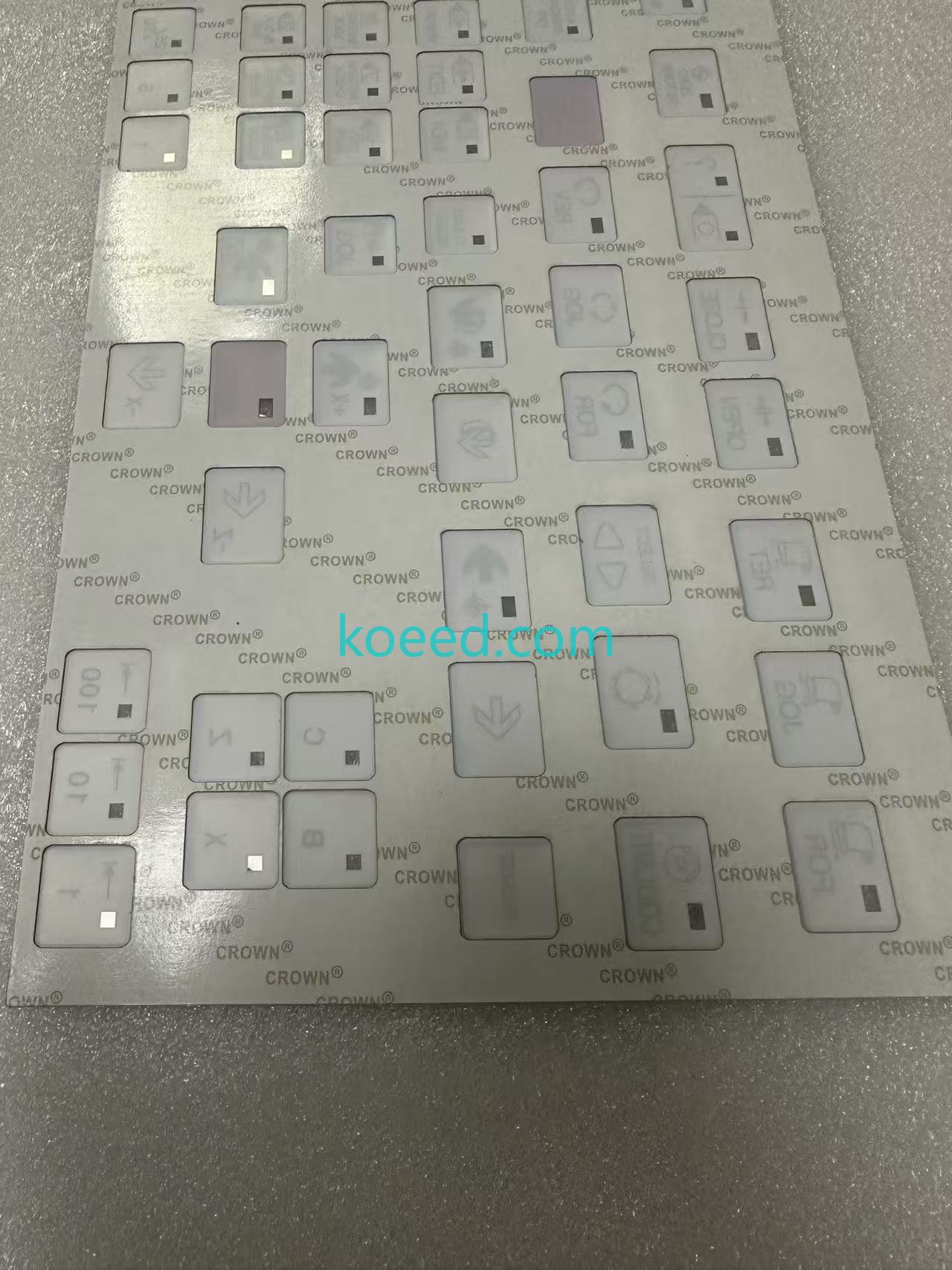
Below is a detailed visual reference of the membrane key sheet overlay — inspect surface finish, tactile dome geometry, connector tail alignment, and adhesive backing uniformity, all of which are quality indicators for 2026-grade industrial overlays.
Maintenance & Troubleshooting: Extending Membrane Overlay Service Life
Preventive Maintenance Protocols (2026 Best Practice)
The membrane overlay's greatest enemy is not mechanical wear — it is chemical ingress at the edge seal and abrasive particulate accumulation under the tactile domes. Adopt the following regimen to push lifecycle beyond 5 million actuations:
| Interval | Action | Tool / Consumable | KPI Alert Threshold |
|---|---|---|---|
| Daily | Dry wipe overlay surface with microfiber cloth | Lint-free microfiber (ISO Class 5) | Visible coolant film = immediate clean |
| Weekly | Inspect edge seal for lifting or delamination | Visual + 10x loupe | Edge lift > 0.5mm = replace within 72h |
| Monthly | Measure key resistance values at connector tail | Digital multimeter (4-wire mode) | Drift > 15% from baseline = flag for predictive replacement |
| Quarterly | Full actuation test — press each key 3x, verify tactile snap | Operator log + IIoT dashboard cross-check | Any key with mushy/dead feel = immediate overlay swap |
| Annually | Replace overlay if actuation count exceeds 80% of rated lifecycle | Predictive maintenance telemetry | Actuation counter > 4M (on 5M-rated overlay) |
Common Failure Modes & Field Resolution
Root Cause (2026 Analysis): In 80% of cases, this is not dome collapse. It is micro-fretting corrosion on the silver-ink traces where the connector tail flexes into the ZIF socket. The 2026 fix: clean ZIF contacts with 99% isopropyl alcohol, apply Caig DeoxIT D5 contact stabilizer, and re-seat. If symptom persists beyond 48 hours, the overlay's conductive traces have degraded — replace immediately to avoid intermittent signals reaching the CNC controller.
FAQ: 2026 CNC Membrane Overlay Hot Topics
Can I use solvent-based cleaners on the membrane overlay surface?
No. While 2026-grade polyester overlays resist mild alkalis and cutting fluids, solvents such as acetone, MEK, toluene, or brake cleaner will permanently cloud the graphic layer and embrittle the polyester substrate within 3–5 exposures. Use only isopropyl alcohol (70–99%) or dedicated electronics-grade surface wipes. Any solvent damage voids the manufacturer's warranty and accelerates edge-seal failure.
How do I know when to replace the overlay versus the entire CNC control panel?
If the underlying PCB switch matrix tests good (continuity and voltage levels within spec per the CNC OEM service manual), a membrane overlay replacement is a $45–$180 fix. If the PCB shows burned traces, lifted pads, or IC failures, a full panel rebuild may be warranted. The overlay itself is the wear item — treat it as a consumable, not a capital repair. 2026 predictive maintenance telemetry helps you distinguish the two with 95%+ confidence before opening the panel.
Is this overlay compatible with FANUC / Siemens / Haas / Mazak CNC lathes?
Membrane key sheet overlays are typically model-specific — the key layout, connector pinout, and tail dimensions must match the exact CNC controller panel. Koeed supplies overlays compatible with major 2026-active CNC families, including FANUC 0i/30i/31i series, Siemens SINUMERIK 828D/840D, Mitsubishi M80/M800, Haas NGC, and legacy Mazak Mazatrol panels. Always cross-reference the OEM part number and connector tail geometry before ordering. Contact our engineering team for pinout verification.
What is the typical lead time and MOQ for custom CNC membrane overlays in 2026?
For standard stocked overlays (common FANUC and Siemens configurations), 48–72 hour dispatch is standard from Koeed's 2026 fulfillment network. Fully custom overlays (custom graphics, non-standard connector tail, embedded FSR layers) typically require 7–14 business days including CAD approval. MOQ for custom runs is 5 units. Volume pricing unlocks at 50+ units with ~22–35% cost reduction.
2026 Supply Chain & Procurement Intelligence
The global membrane switch and overlay supply chain has matured significantly through 2026, with nearshored production hubs in Southeast Asia and Mexico reducing lead times from the 12–16 weeks seen during 2021–2023 disruptions to a current average of 5–8 business days for standard industrial overlays. Koeed's distributed inventory model ensures that CNC lathe operators in North America, Europe, and APAC can access replacement overlays without the extended downtime that plagued the industry during the semiconductor/logistics crunch.
For procurement managers, the 2026 TCO calculation strongly favors blanket POs with scheduled releases — locking in pricing against a volatile polymer raw material market while ensuring just-in-time delivery aligned with predictive maintenance schedules.
🔒 Ready to Upgrade Your CNC Lathe HMI Reliability?
Whether you need a single replacement overlay for a legacy FANUC panel or a fleet-wide predictive-maintenance-ready retrofit, the Koeed engineering team is ready to support your 2026 smart-factory roadmap. Let's discuss your specific CNC controller model, operating environment, and volume requirements.
Response within 4 business hours | MOQ from 1 unit | Worldwide DDP shipping available


