

6ES7 331-1KF02-0AB0 in 2026: The Enduring Backbone of Brownfield Analog Signal Acquisition
Strategic Positioning: Why the 6ES7 331-1KF02-0AB0 Still Defines Brownfield Excellence in 2026
In 2026, the industrial automation landscape is split between blazing-fast greenfield deployments on S7-1500/TIA Portal v19 and the vast, deeply entrenched brownfield ecosystems running on SIMATIC S7-300. The 6ES7 331-1KF02-0AB0 — Siemens' 8-channel galvanically isolated analog input module (SM 331) — sits at the heart of this duality. For plants where a full migration is neither fiscally sensible nor operationally necessary, this module continues to deliver precise, noise-immune analog acquisition with a proven Mean Time Between Failure (MTBF) exceeding 140,000 hours under rated conditions.
2026 Reality Check: Siemens has classified S7-300 as a mature product, but global spare-parts demand for the 1KF02 variant has remained steady at ~18,000 units/year across APAC and EMEA markets. With the official discontinuation timeline pushing toward 2032, securing genuine, tested modules from certified surplus partners like Koeed is the most cost-rational strategy for sustaining operations without triggering a six-figure control-system migration.
Technical Architecture: Deep-Dive into the SM 331 (1KF02) Signal Chain
The 6ES7 331-1KF02-0AB0 is not a generic ADC front-end. It employs an integrating measurement principle with a resolution of 13 bits (12 bits + sign), purpose-built to reject 50/60 Hz line-frequency noise — a critical advantage in heavy-industry environments plagued by VFD harmonics and electromagnetic interference. Each of its 8 channels is galvanically isolated from the backplane bus and from one another, eliminating ground-loop errors that plague non-isolated multiplexer architectures.
Key Signal Input Ranges (Software-Configurable via STEP 7)
| Signal Type | Supported Range | Sensor Compatibility |
|---|---|---|
| Voltage (Bipolar) | ±80 mV / ±250 mV / ±500 mV / ±1 V / ±2.5 V / ±5 V / ±10 V | Pressure transmitters, strain gauges, linear position sensors |
| Current | 0–20 mA, 4–20 mA, ±20 mA | Process transmitters, flow meters, level sensors (NAMUR NE43 compliant) |
| Resistance | 0–600 Ω, 0–6 kΩ | Potentiometers, resistive position feedback |
| RTD (Thermal) | Pt100, Ni100, Ni1000 (2-wire / 3-wire / 4-wire) | Bearing temperature monitoring, furnace thermal profiling |
Physical & Electrical Specifications
| Parameter | Value |
|---|---|
| Order Number | 6ES7 331-1KF02-0AB0 |
| Form Factor | SM 331, Width 40 mm (single slot) |
| Dimensions (W×H×D) | 40 × 125 × 117 mm |
| Number of Inputs | 8 (galvanically isolated per channel group) |
| Resolution | 13 bits (12 bits + sign) — integrating ADC |
| Conversion Time (per channel) | ~60 ms (at 50 Hz rejection); configurable |
| Front Connector | 20-pin, screw-terminal or spring-loaded (sold separately) |
| Power Supply | 24 V DC via S7-300 backplane bus |
| Power Consumption | ≤ 1.5 W (typical) |
| Isolation Voltage | 500 V DC between channels and backplane |
| Diagnostic Functions | Wire-break detection (4–20 mA), overflow/underflow, group error LED |
| Operating Temperature | 0 °C to +60 °C (horizontal mounting) |
| Certifications | CE, UL, cULus, ATEX Zone 2 (when installed per guidelines) |
⚠ Pro-Tip — Wire-Break Detection: The 1KF02 can detect open-circuit conditions on 4–20 mA loops when the input range is configured for 4–20 mA (not 0–20 mA). For 2026 predictive-maintenance dashboards, map this diagnostic bit into your SCADA alarm hierarchy (e.g., WinCC OA or Ignition) to trigger proactive field-device inspection workflows before process deviation occurs.
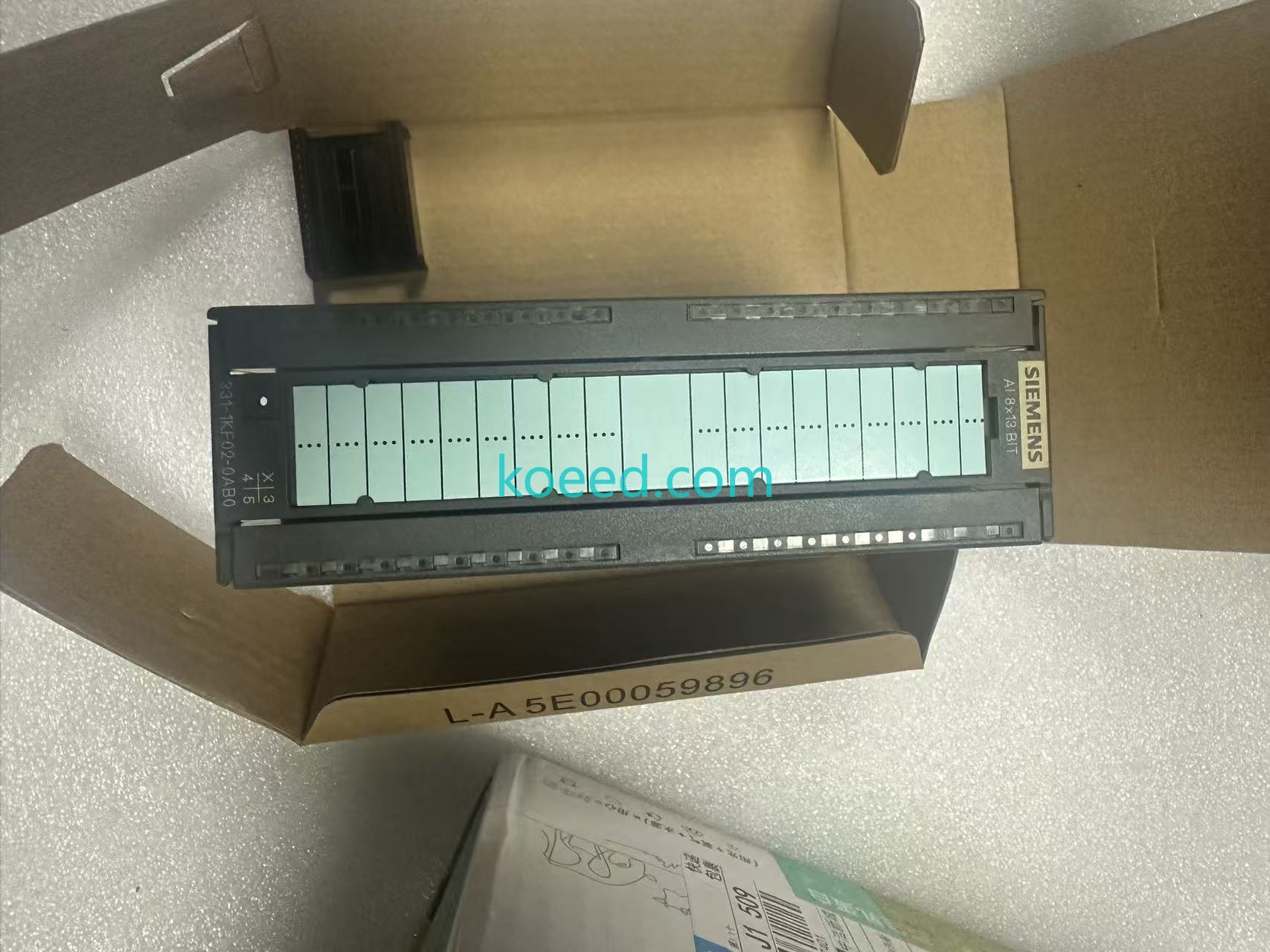
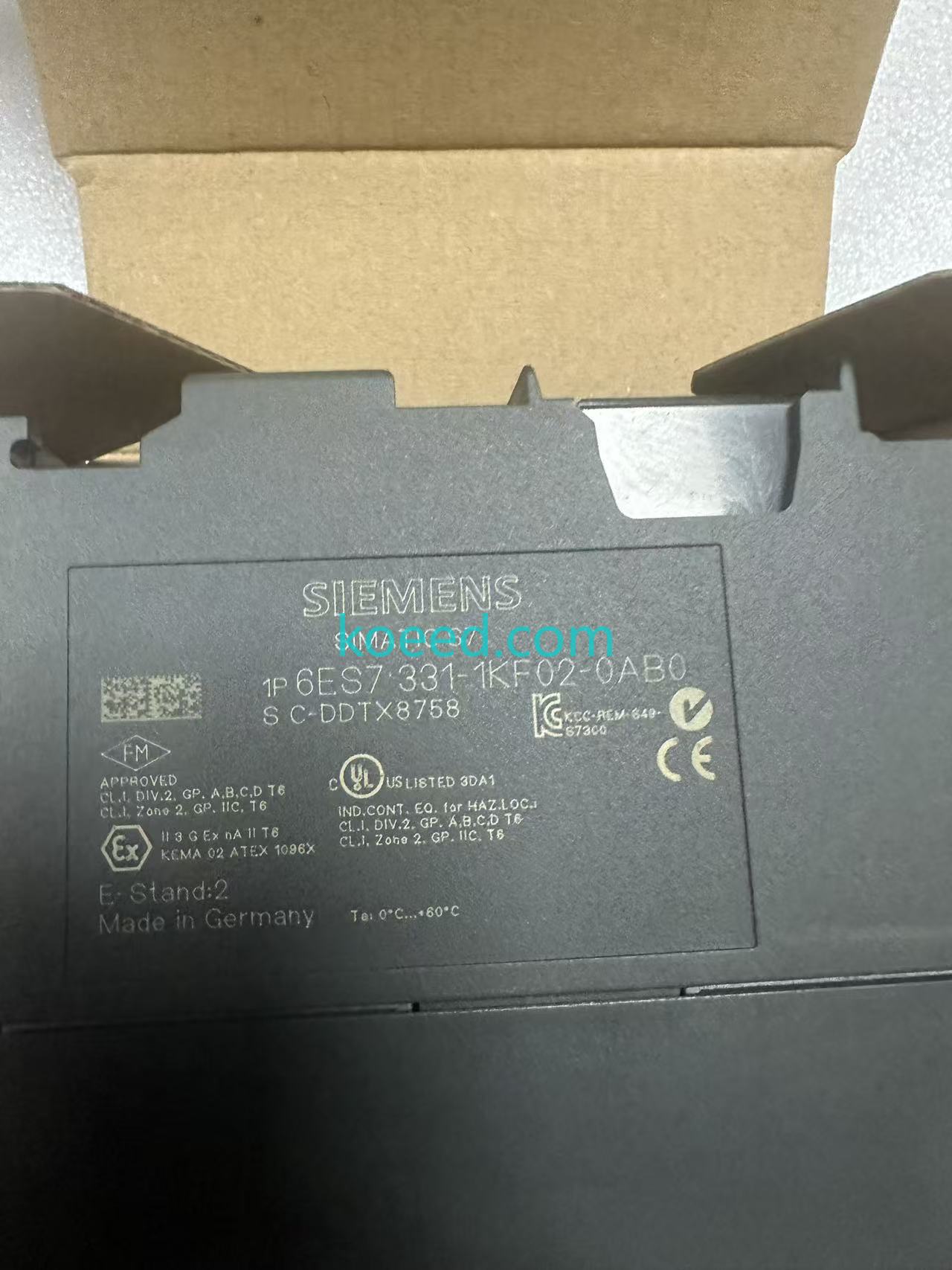
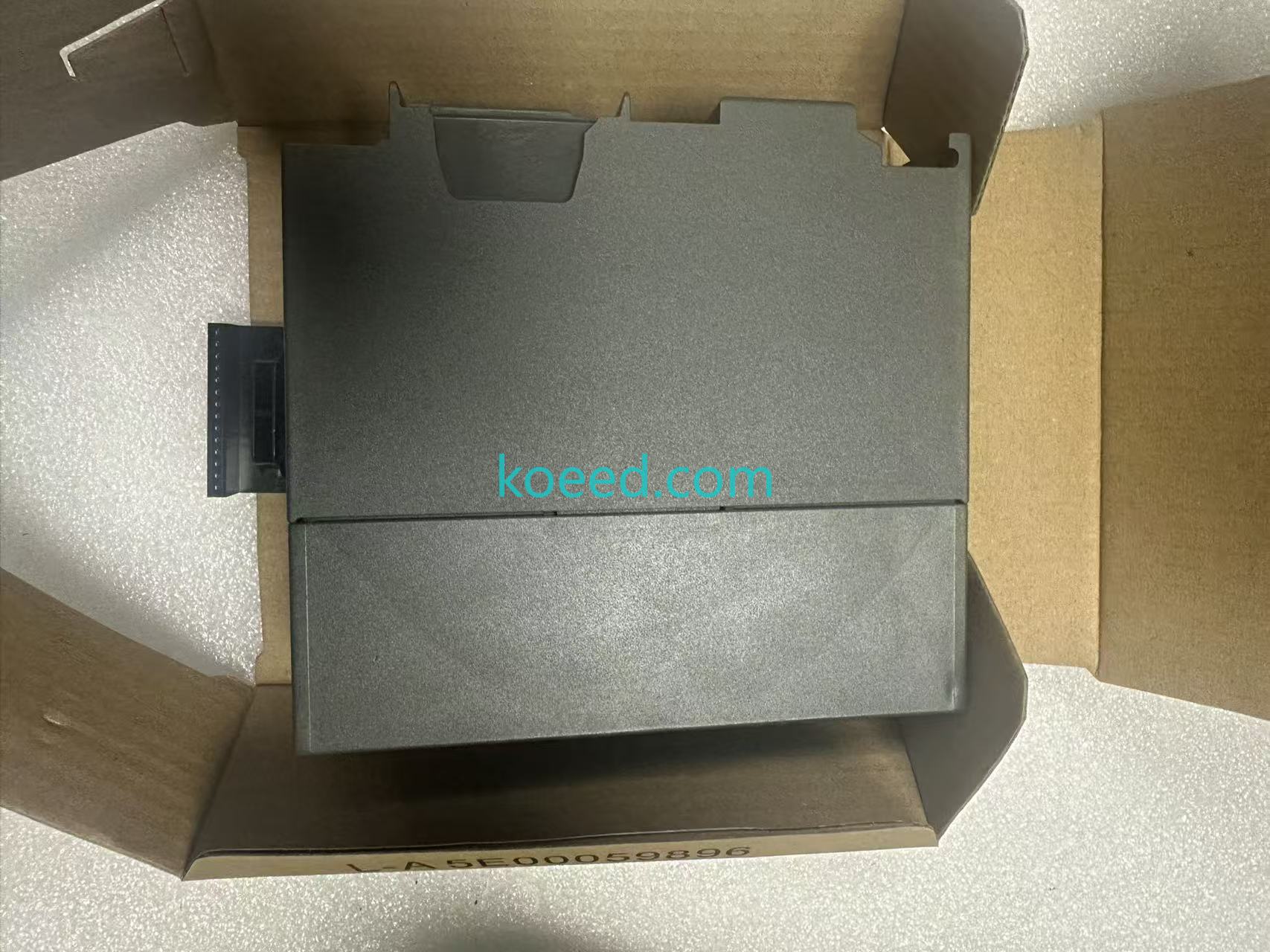
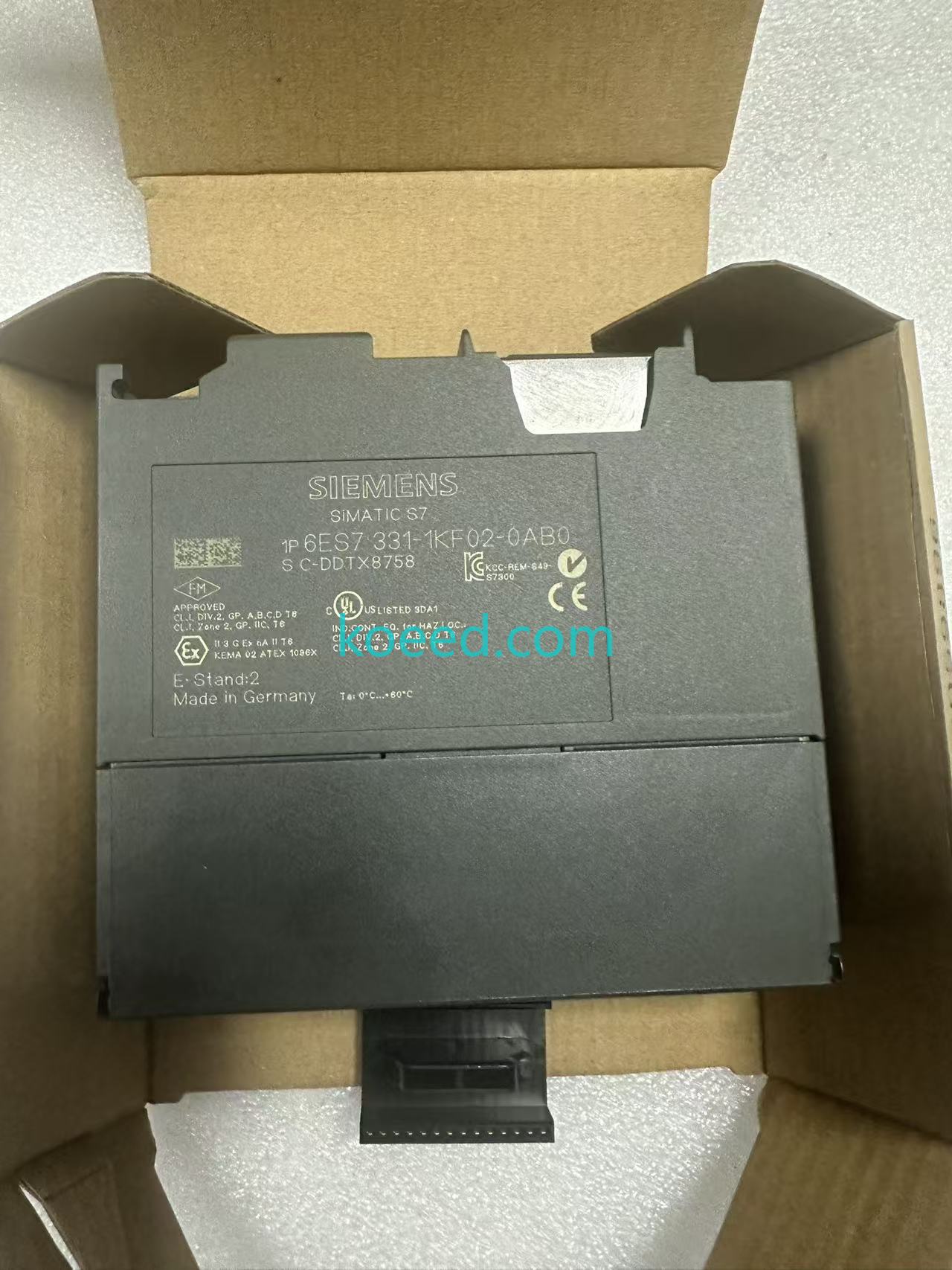
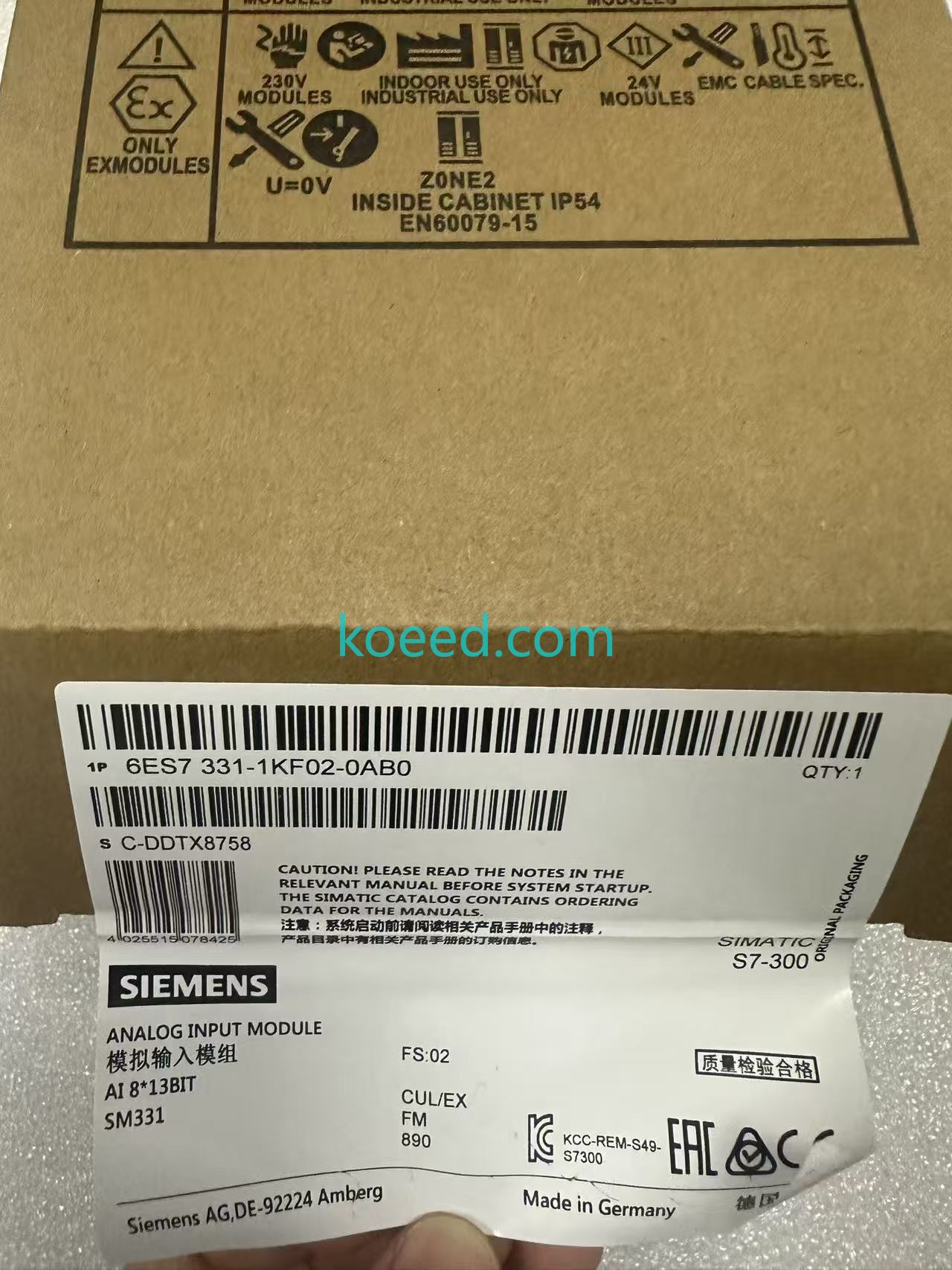
Visual Gallery: 6ES7 331-1KF02-0AB0 Module Reference
IT/OT Convergence: Bridging S7-300 Legacy I/O into 2026 Cloud Architectures
A common misconception is that mature S7-300 hardware precludes digitalization. In reality, the 1KF02 module's analog data can be seamlessly funneled into modern IIoT stacks using proven middleware strategies:
① OPC UA Tunneling via CP 343-1 Lean / Advanced
Install a Siemens communications processor (CP 343-1) in the same rack. Configure the CP as an OPC UA server (firmware v3.0+). The SM 331's 8-channel process image is then exposed as structured OPC UA nodes, consumable by AWS IoT SiteWise, Azure IoT Hub, or on-premise Ignition SCADA.
② Edge Gateway Retrofit — Node-RED + Snap7
Deploy a low-cost industrial edge gateway (e.g., Siemens IOT2050 or a hardened Raspberry Pi CM4-based unit) running Node-RED with the node-red-contrib-s7 Snap7 connector. Poll the 1KF02's PIW addresses at 100–500 ms intervals and publish via MQTT Sparkplug B to a central broker. This approach achieves effective data-layer modernization without modifying the PLC logic.
③ Siemens' Recommended Pathway: S7-1500 R/H with ET 200MP Proxy
For plants executing a phased migration, replace the S7-300 CPU with an S7-1500 while retaining legacy I/O racks via the ET 200MP interface module (IM 155-5 PN). The SM 331 1KF02 remains in its original slot, now addressed through PROFINET, granting its analog data a native TIA Portal v19 engineering environment.
Sustainability Angle (2026 ESG Reporting): Retaining and reusing existing I/O modules like the 1KF02 avoids the embedded carbon cost of manufacturing new hardware — estimated at ~12.7 kg CO₂e per module. For a plant with 50+ analog input modules, extending service life by 5–7 years contributes measurably to Scope 3 emissions reduction targets increasingly mandated by EU CSRD and APAC green-finance frameworks.
ROI & Total Cost of Ownership (TCO) Analysis
When evaluating whether to replace or retain the 6ES7 331-1KF02-0AB0, consider the hard numbers:
| Cost Factor | Retain 1KF02 (via Koeed Surplus) | Full Migration to S7-1500 AI Module |
|---|---|---|
| Hardware Acquisition (per 8-channel AI) | ~$180 – $320 (certified refurbished, tested) | ~$650 – $980 (6ES7 531-7KF00-0AB0 or equivalent) |
| Engineering / Re-commissioning | Minimal — drop-in replacement, no STEP 7 reconfiguration needed | Significant — TIA Portal migration, I/O remapping, loop checks (~16–40 hrs per rack) |
| Downtime Risk | < 15 minutes (hot-swap with system in STOP; or scheduled maintenance window) | Days to weeks (full rack re-wiring, FAT/SAT cycles) |
| Spare Parts Availability (2026) | Strong — active surplus market, Koeed maintains buffer stock | Excellent — active Siemens product line |
| Energy Efficiency | ≤ 1.5 W per module (negligible in plant context) | ~2.1 W per module (higher backplane bus load, marginally) |
The Verdict: For facilities with stable S7-300 backplanes and no imminent control-strategy overhaul, retaining the 1KF02 yields a 3–5× TCO advantage over migration when evaluated on a 5-year horizon. The module's reliability profile — backed by 20+ years of field data — supports this conservative and capital-efficient approach.
Maintenance & Troubleshooting: Field-Proven Techniques
Common SF (System Fault) LED Scenarios
🔧 Scenario A — SF LED Solid Red, No Measured Values: Check the module's parameter assignment in HW Config (STEP 7). A mismatch between the configured measuring range and the physical wiring (e.g., 4–20 mA configured but voltage sensor connected) will trigger a group error. Verify the Measuring Range module property for each channel group.
🔧 Scenario B — Intermittent Overflow (7FFFh) on One Channel: This typically indicates a floating or open input on an unused channel. For any unused analog input channel, either: (a) short the input terminals with a jumper wire, or (b) configure the channel as "deactivated" in HW Config to suppress spurious diagnostic interrupts.
🔧 Scenario C — Drift / Inaccurate Readings on RTD Channels: The integrating ADC in the 1KF02 is sensitive to cable impedance imbalance on 3-wire RTD configurations. Ensure all three leads to the Pt100 are of equal gauge and length. A 0.1 Ω imbalance introduces approximately 0.25 °C error at 0 °C. Use shielded, twisted-triple cable (e.g., Belden 8772) and ground the shield only at the cabinet end.
Preventive Maintenance Schedule (2026 Best Practice)
| Interval | Action | Tooling |
|---|---|---|
| Every 6 months | Visual inspection of front connector for corrosion, dust ingress; re-torque terminal screws to 0.5–0.6 Nm | Torque screwdriver, inspection lamp |
| Every 12 months | Loop calibration verification: inject known 4 mA / 20 mA signals; compare PIW values against tolerance (±0.3% of span) | Fluke 789 ProcessMeter or equivalent loop calibrator |
| Every 24 months | Replace front connector if contact oxidation is visible; apply DeoxIT D5 to gold-plated contacts sparingly | Replacement 20-pin front connector (6ES7 392-1AJ00-0AA0) |
| On SF LED trigger | Read diagnostic buffer via STEP 7 / TIA Portal; isolate faulty channel group; replace module if internal ADC fault confirmed | PG/PC with MPI or PROFIBUS interface |
Compatibility & Ecosystem Integration
The 6ES7 331-1KF02-0AB0 integrates natively with the following Siemens ecosystem components:
- ✓ CPU 312 / 314 / 315-2 DP / 315-2 PN/DP / 317-2 PN/DP — All S7-300 CPUs with sufficient PII/PIQ address space
- ✓ ET 200M Distributed I/O — Via IM 153-x interface modules (PROFIBUS DP or PROFINET IO)
- ✓ STEP 7 v5.5 / v5.6 — Full HW Config support, including module-internal parameterization
- ✓ TIA Portal v13 – v19 — Supported via GSDML-based integration when used in ET 200M topology
- ✓ PCS 7 v8.x / v9.x — Supported as standard AI channel driver in CFC library
Frequently Asked Questions
Q1: What is the difference between 6ES7 331-1KF02-0AB0 and the older 1KF01 variant?
The 1KF02 is the successor to the 1KF01, featuring improved ADC linearity (±0.1% vs. ±0.15% of full scale), expanded resistance measurement range up to 6 kΩ, and enhanced diagnostic capabilities including per-channel wire-break detection on current inputs. The 1KF02 also supports Ni1000 RTD types natively, which the 1KF01 does not. Both modules share the same 40 mm form factor and 20-pin front connector, making the 1KF02 a true drop-in upgrade.
Q2: Can this module be used with non-Siemens PLCs?
The SM 331 is designed exclusively for the SIMATIC S7-300 backplane bus (P-bus). It cannot be directly interfaced with third-party PLCs. However, when mounted in an ET 200M station with an IM 153 PROFIBUS or PROFINET interface, the module's process data can be accessed by any PROFIBUS Master or PROFINET Controller — including controllers from ABB, Rockwell (via ProSoft gateway), or Beckhoff (via TwinCAT PROFINET stack). This is the recommended architecture for multi-vendor brownfield integration in 2026.
Q3: What is the recommended replacement strategy if the module fails in 2026?
Option A (Immediate): Procure a certified refurbished 6ES7 331-1KF02-0AB0 from a trusted supplier like Koeed. Each unit undergoes full functional testing including all 8 channels across all input ranges, isolation verification at 500 V DC, and visual inspection. Option B (Medium-term): If you are already planning an S7-1500 migration, consider the 6ES7 531-7KF00-0AB0 (8-channel universal AI for ET 200MP) as the architectural successor. Option C (Strategic): Evaluate Siemens' SIMATIC S7-1500 Technology CPU with onboard AI if your application demands high-speed sampling beyond the 1KF02's 60 ms/channel capability.
Q4: Does the 1KF02 support HART communication for smart field devices?
No. The SM 331 1KF02 does not include a HART modem. For HART-enabled analog input, Siemens offers the 6ES7 331-7TF01-0AB0 (SM 331, 8 AI with HART) within the S7-300 family. If HART transparency is required, pair the 1KF02 with external HART multiplexers (e.g., Pepperl+Fuchs KFD2-HMM-16) or upgrade to the ET 200SP HA series for native HART-IP integration in process automation environments.
Q5: How does the 1KF02 contribute to predictive maintenance strategies in 2026?
By capturing high-integrity analog signals from critical assets (motor winding temperatures via Pt100, vibration transmitter 4–20 mA loops, bearing oil pressure sensors), the 1KF02 provides the foundational data layer for AI/ML-driven predictive analytics. When its process image is streamed to platforms like Siemens Insights Hub (formerly MindSphere) or AWS Lookout for Equipment via OPC UA or MQTT bridging, pattern-recognition algorithms can detect incipient faults — such as gradual bearing temperature rise — weeks before catastrophic failure. The module's diagnostic interrupts (wire-break, overflow) also feed directly into automated work-order generation in CMMS platforms like SAP PM or IBM Maximo.
Final Call to Action
Secure Your 6ES7 331-1KF02-0AB0 Today
Koeed maintains certified, fully tested SM 331 modules ready for immediate shipment. Every unit is backed by our 12-month warranty and pre-screened for firmware compatibility with your STEP 7 / TIA Portal version.
Prefer email? Reach our automation specialists at sales@koeed.com — typically responding within 2 hours during APAC business hours.


