

MCC312-18I01 Thyristor Module: 2026 Guide to 1800V/320A Phase-Leg Power Control for Smart Factories | Koeed
Strategic Overview: The MCC312-18I01 in 2026's Intelligent Power Infrastructure
In 2026, the industrial automation sector has fully embraced the convergence of operational technology (OT) and information technology (IT). Power semiconductor selection is no longer a purely electrical engineering decision — it is a strategic one that impacts data visibility, energy KPIs, and predictive maintenance workflows. The IXYS MCC312-18I01 (also designated MCC312-18IO1), now manufactured under the Littelfuse portfolio, stands as a benchmark dual-thyristor phase-leg module purpose-built for high-reliability rectification and AC power control in Industry 4.0 environments.
With a blocking voltage of 1800V and an average on-state current rating of 320A (RMS 600A), this module delivers the ruggedness required by motor drives, industrial soft starters, UPS systems, welding equipment, and inductive heating rigs. The module's Direct Copper Bonded (DCB) Al2O3 ceramic substrate with an integrated copper base plate ensures superior thermal cycling endurance — a critical factor for factories targeting 24/7 uptime with minimal service intervals. Koeed supplies the MCC312-18I01 as part of its curated power semiconductor portfolio, backed by rigorous quality assurance protocols.
From a 2026 IT/OT convergence standpoint, the MCC312-18I01 integrates seamlessly into smart MCC (Motor Control Center) panels where gate-trigger circuits are increasingly monitored by edge-computing gateways. Parameters such as gate current drift, junction temperature estimation via VT sensing, and cumulative conduction hours are streamed to cloud-based CMMS (Computerized Maintenance Management Systems). This transforms a traditionally 'dumb' thyristor into a data-rich asset within the digital twin of the plant floor.
Technical Benchmarking: MCC312-18I01 vs. Legacy & Competing Modules
The table below provides a structured comparison between the MCC312-18I01 and representative earlier-generation or competing thyristor modules commonly found in industrial environments. This benchmarking highlights why the MCC312 series has become a preferred choice for brownfield retrofits and new greenfield deployments in 2026.
| Parameter | MCC312-18I01 (IXYS/Littelfuse) | Legacy MCC224-18IO1 (Previous Gen) | Generic 1600V SCR Module |
|---|---|---|---|
| Repetitive Peak Reverse Voltage (VRRM) | 1800 V | 1800 V | 1600 V |
| Average On-State Current (ITAV) | 320 A | 240 A | 250 A |
| RMS On-State Current (ITRMS) | 600 A | 375 A | 390 A |
| Forward Voltage Drop (VTM) | 1.32 V | 1.40 V | 1.55 V |
| Threshold Voltage (VT0) | 1.06 V | 1.10 V | 1.20 V |
| Slope Resistance (rT) | 0.68 mΩ | 0.95 mΩ | 1.10 mΩ |
| Gate Trigger Current (IGT) | 150 mA | 150 mA | 200 mA |
| Turn-Off Time (tq) | 200 μs | 200 μs | 250 μs |
| Operating Temperature Range | -40°C to +140°C | -40°C to +125°C | -25°C to +125°C |
| Isolation | Isolated base plate (DCB Al2O3) | Isolated base plate | Non-isolated or basic |
| Package Standard | International standard, planar passivated | International standard | Varies by OEM |
The data reveals clear advantages: the MCC312-18I01's 33% higher current capacity versus the MCC224 series, combined with a lower forward voltage drop (1.32V vs. 1.55V for generics), translates directly into reduced conduction losses and lower thermal management overhead. The extended temperature ceiling of +140°C provides an additional safety margin essential for hot-aisle installations in 2026's densified factory floors. Koeed offers the MCC312-18I01 at competitive pricing for both single-unit replacements and volume OEM procurement.
Visual Gallery & Physical Architecture
The MCC312-18I01's physical design reflects decades of IXYS engineering heritage — now Littelfuse — with a form factor that prioritizes thermal dissipation, mechanical robustness, and ease of busbar integration. The isolated base plate eliminates the need for external insulation between the module and the heatsink, simplifying assembly and improving thermal impedance. Below is a detailed visual reference of the module from multiple angles, including pinout diagrams and packaging inspection imagery.
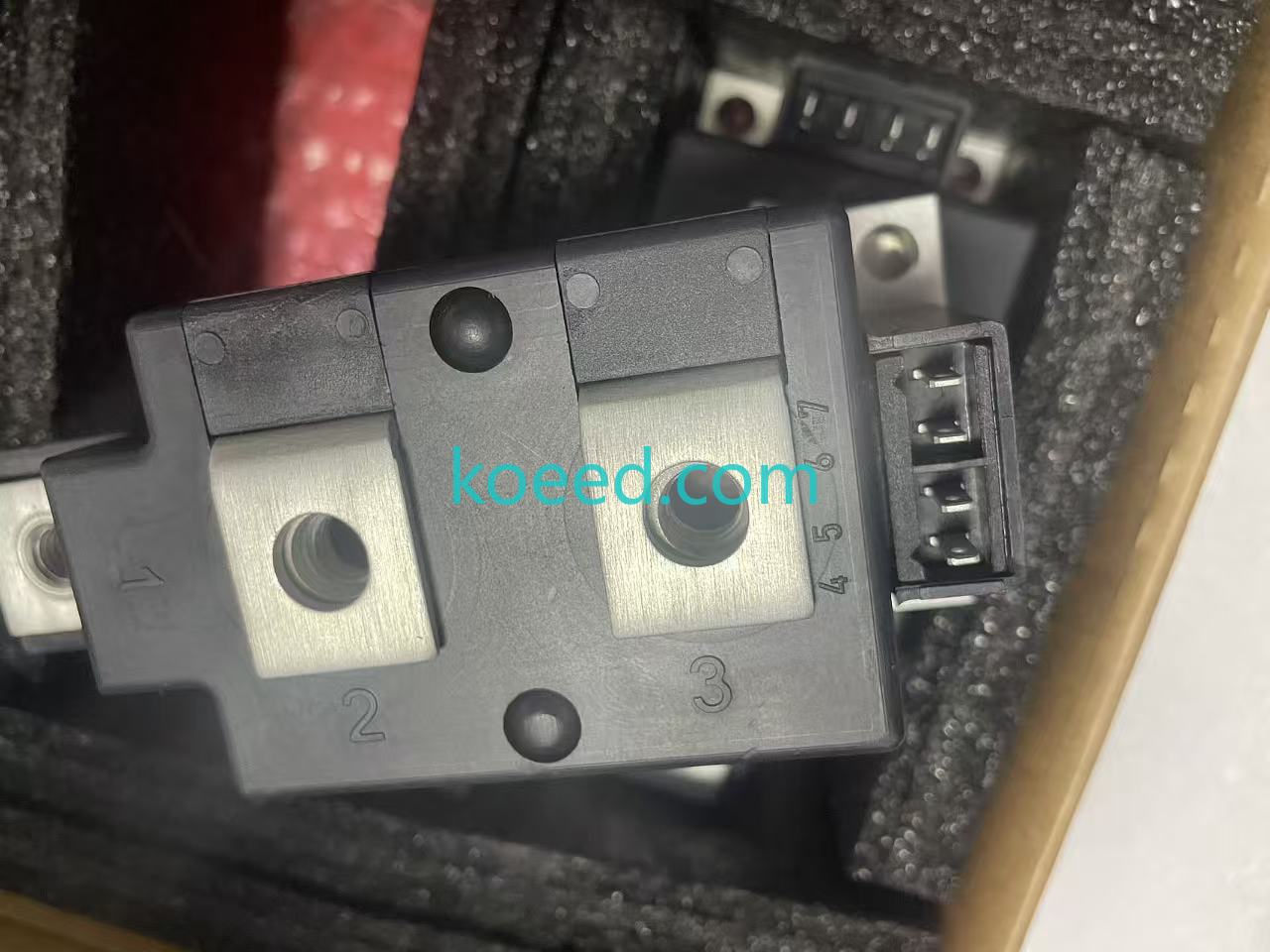
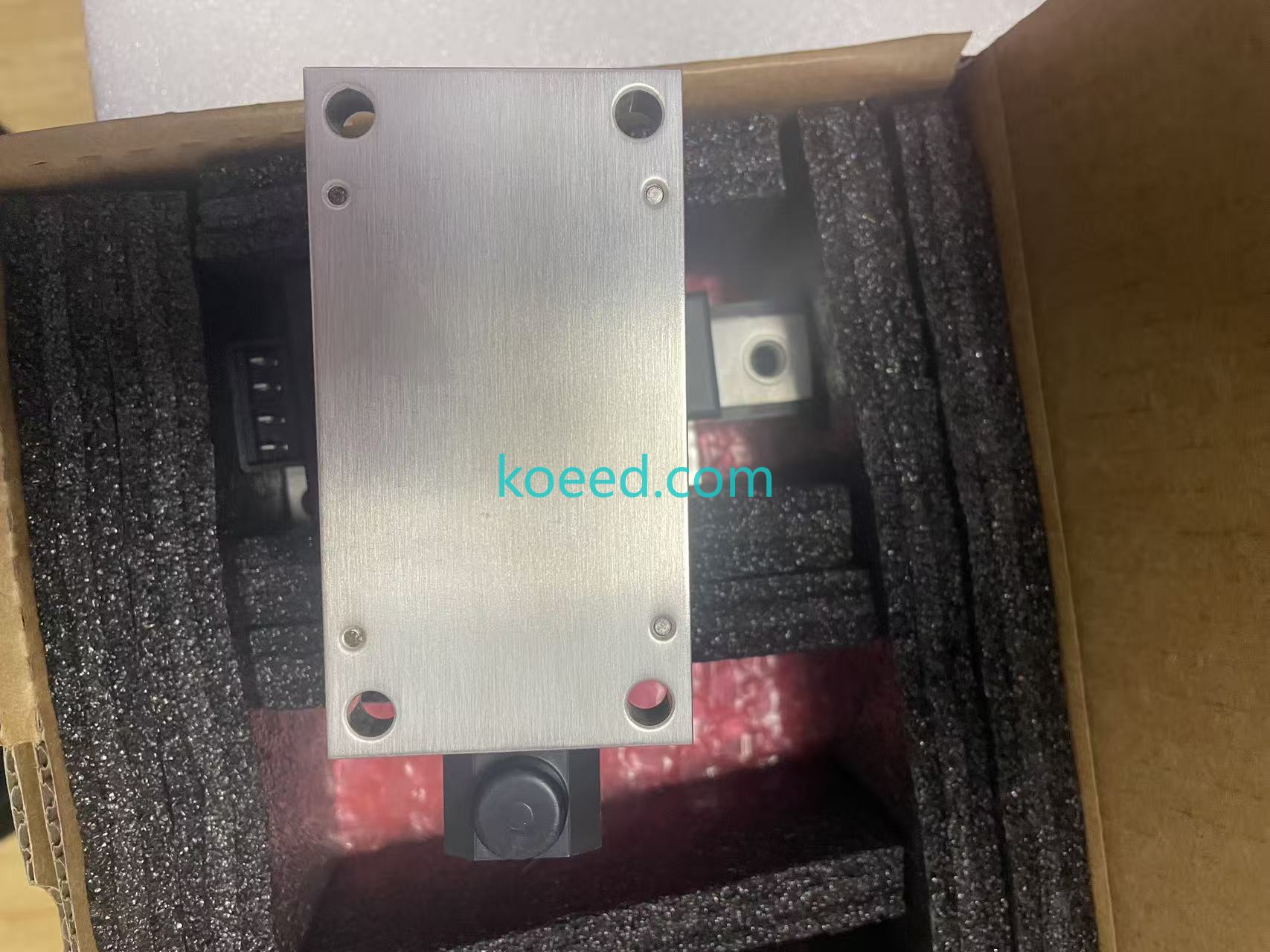
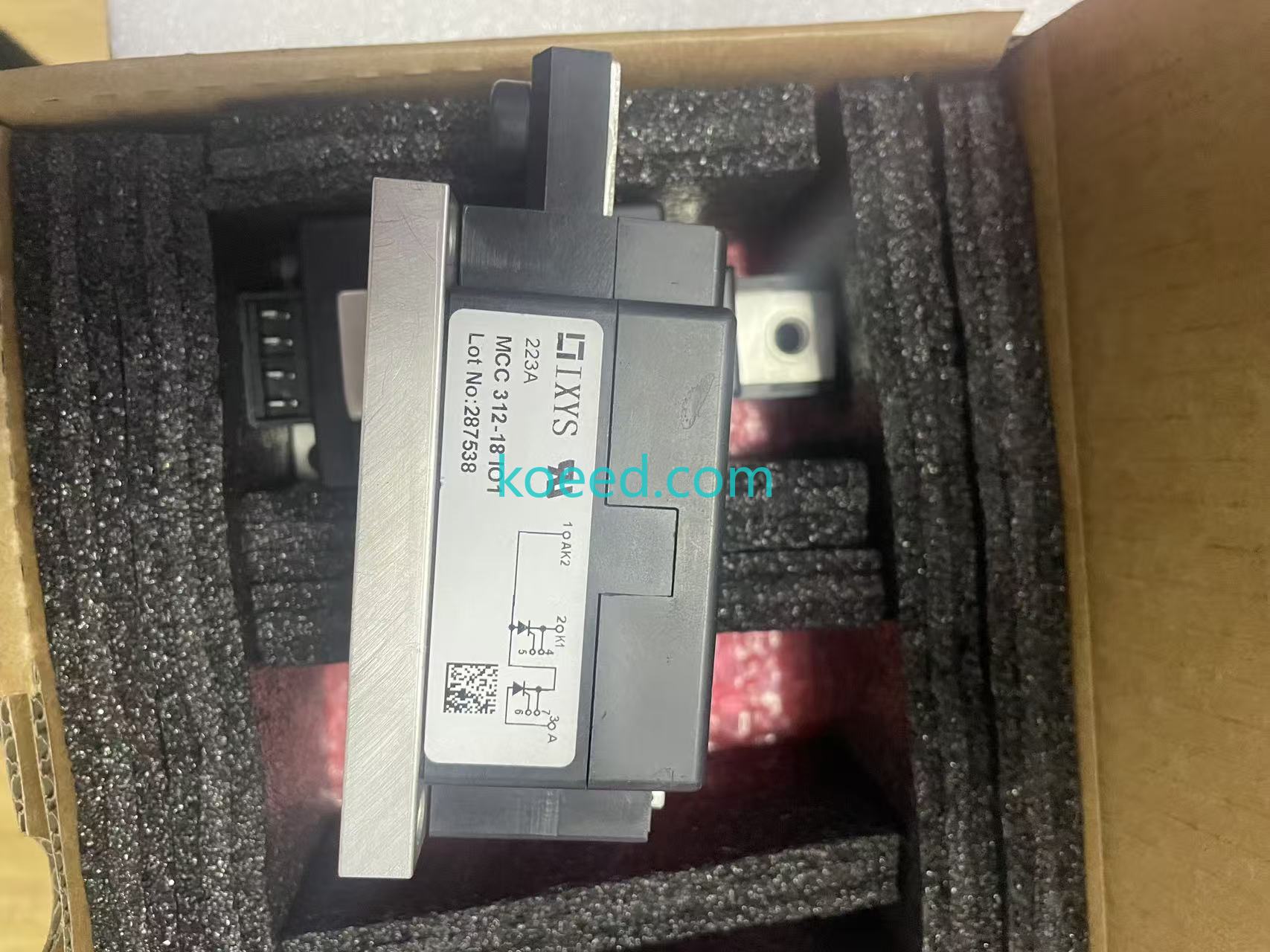
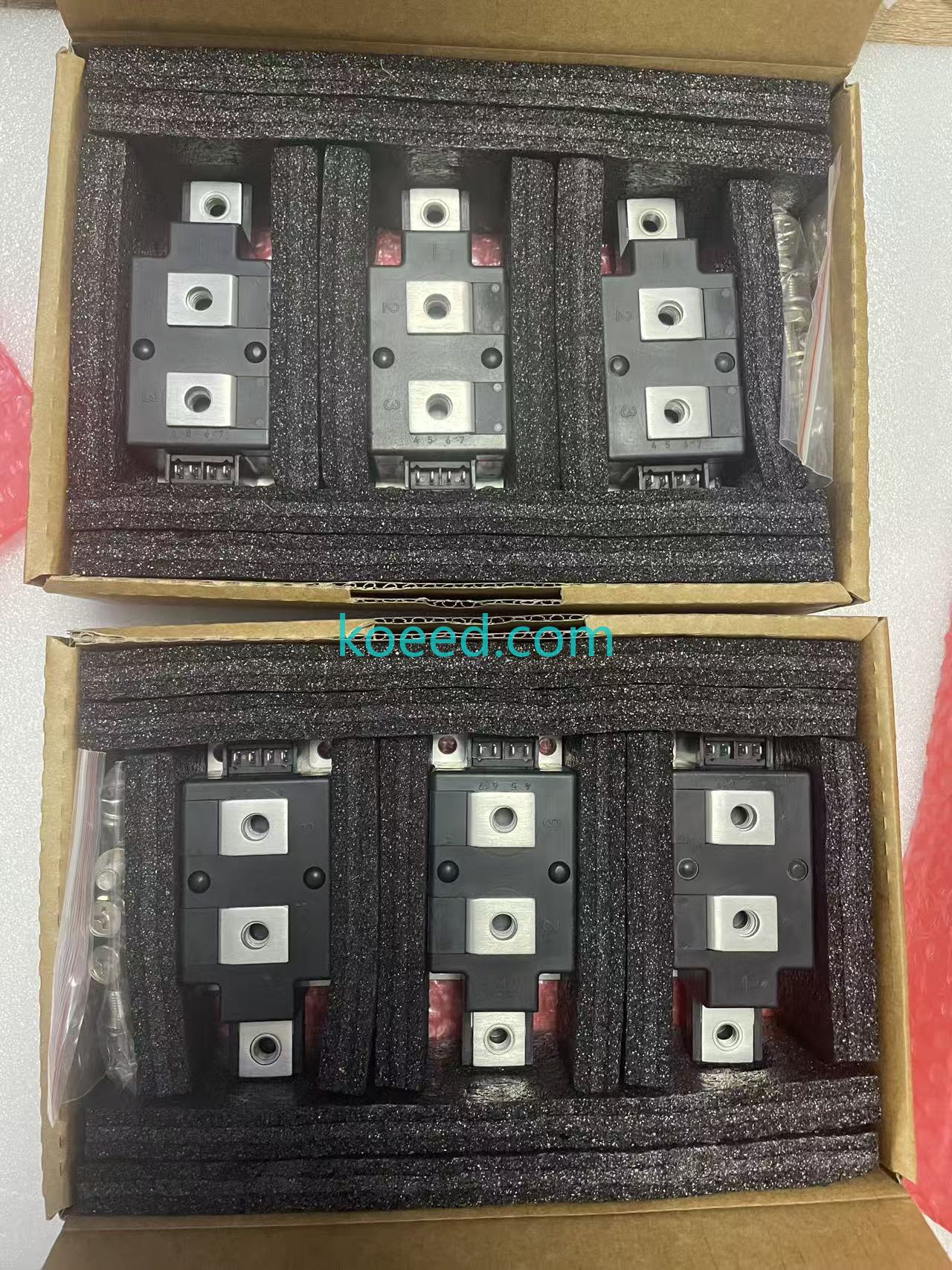
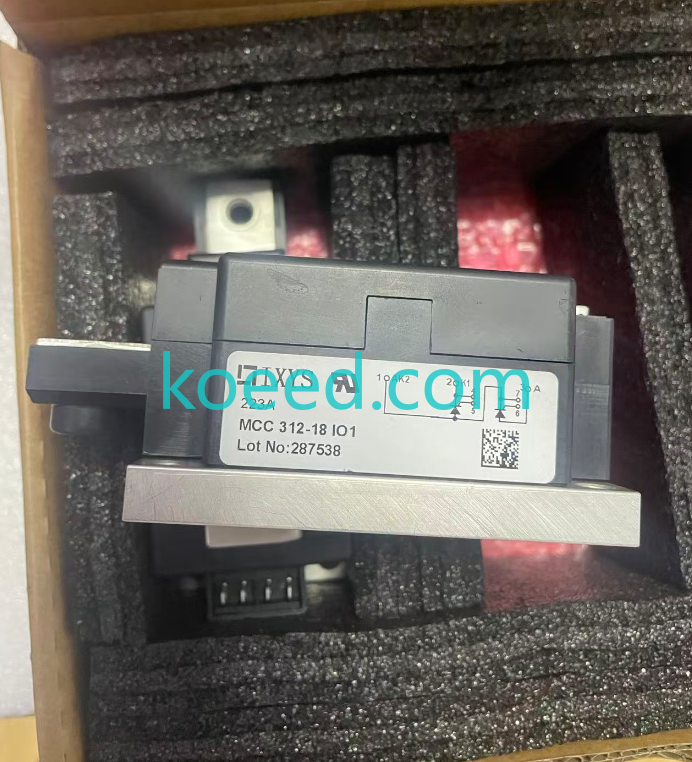
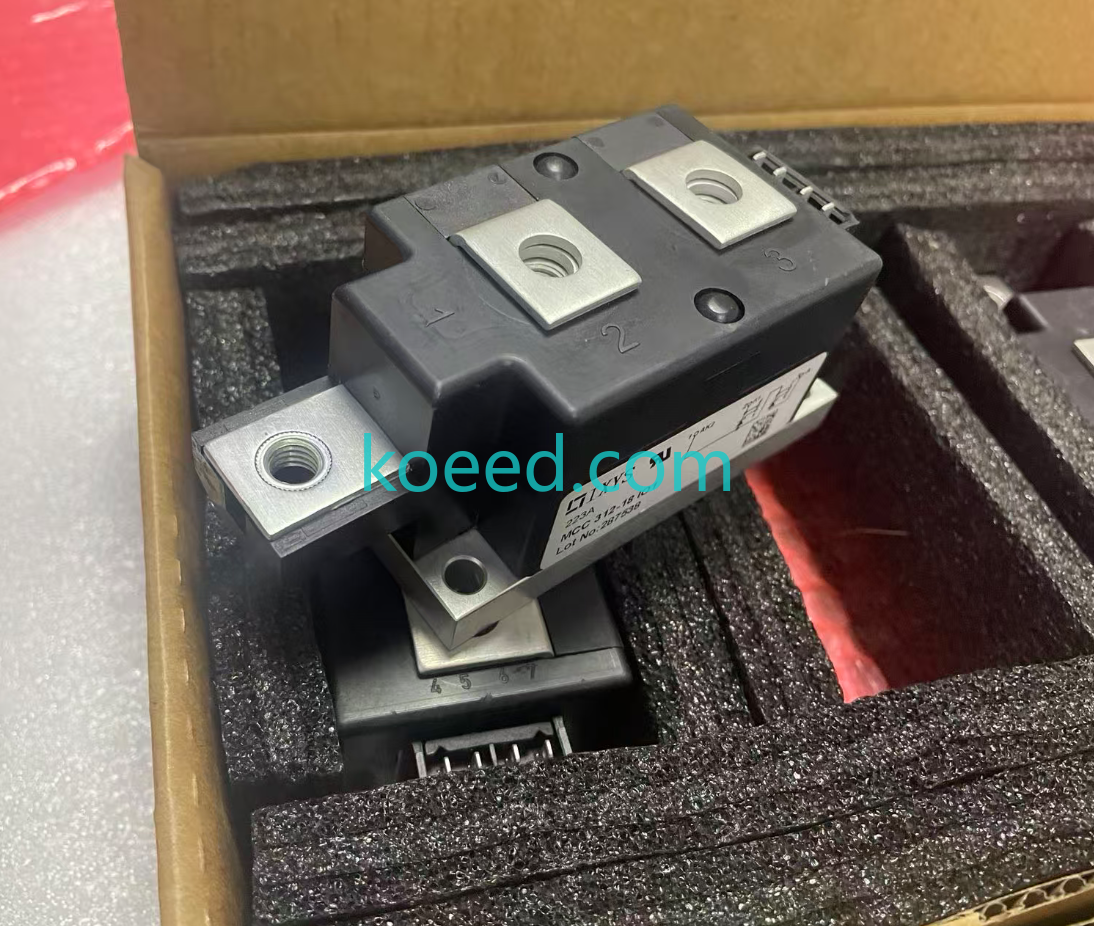
The video above provides a hands-on walkthrough of the module's physical inspection, highlighting terminal integrity, laser-engraved markings, and the flatness of the copper base plate — all critical quality indicators verified by Koeed before the MCC312-18I01 is shipped.
IT/OT Convergence: Integrating the MCC312-18I01 into Smart Motor Control Architectures
The 2026 industrial landscape demands that every power component contributes data to the digital ecosystem. The MCC312-18I01, while a discrete thyristor module, is increasingly deployed within intelligent sensor-equipped power stacks. Here is how leading plants are achieving convergence:
Edge-Enabled Gate Drive Monitoring
Modern gate drive boards paired with the MCC312-18I01 now incorporate IoT-enabled gate current sensors that log IGT trends over time. A gradual increase in required gate trigger current can signal junction degradation long before catastrophic failure. This data is transmitted via OPC UA or MQTT to the plant's SCADA historian, enabling predictive maintenance tickets to be auto-generated in SAP or Maximo.
Junction Temperature Estimation Without Thermocouples
By leveraging the known temperature coefficient of the forward voltage drop (~−2 mV/°C), edge processors can estimate the virtual junction temperature (Tvj) of each thyristor in real time. Combined with ambient temperature data from the cabinet's environmental sensors, the system can flag thermal anomalies caused by degraded thermal interface material (TIM) or failing cooling fans — weeks before an overtemperature trip occurs.
Digital Twin Synchronization
In advanced 2026 deployments, the MCC312-18I01's operational parameters feed directly into a physics-based digital twin of the power converter. This twin simulates aging effects such as bond-wire lift-off and solder fatigue, correlating them with actual electrical signatures. Procurement teams at Koeed's industrial clients use this data to pre-order replacement MCC312-18I01 modules before production throughput is impacted.
ROI & Total Cost of Ownership: The 2026 Business Case
Selecting the MCC312-18I01 is not merely a technical decision — it has quantifiable financial implications across the asset lifecycle. Below is a TCO analysis framework for a typical 6-pulse industrial rectifier using three MCC312-18I01 modules versus a generic alternative.
Sustainability & Energy Impact
In 2026, Scope 2 emissions reporting is mandatory across most industrial jurisdictions. The MCC312-18I01's low forward voltage drop (1.32V) and low slope resistance (0.68 mΩ) directly reduce I²R losses. For a 500 kW motor drive operating 6,000 hours annually, the efficiency advantage versus a generic 1.55V module can save approximately 8,200 kWh per year — equivalent to roughly 3.5 metric tons of CO2 (depending on grid mix). Across a fleet of 50 drives, this represents a meaningful contribution to corporate net-zero targets.
Maintenance, Troubleshooting & Predictive Diagnostics
Common Failure Modes & Diagnostic Codes (2026 Smart Gate Driver Context)
| Symptom / Edge Alert Code | Likely Root Cause | Recommended Action |
|---|---|---|
| IGT_DRIFT_HIGH — Gate trigger current exceeds 180 mA | Gate-cathode junction degradation; potential moisture ingress in terminal area | Inspect gate lead crimps; measure gate-cathode resistance (should be 10–50 Ω typical). If >100 Ω, plan module replacement via Koeed MCC312-18I01 stock. |
| VF_DELTA_POS — Forward voltage increase >5% from baseline | Bond-wire degradation or early solder fatigue in one of the parallel thyristor segments | Perform thermographic inspection under load. If hot-spot exceeds 15°C above neighboring modules, schedule replacement within next planned downtime window. |
| THERMAL_RUNAWAY — Tvj rising despite constant load | Clogged heatsink fins, failed cooling fan, or TIM pump-out | Immediate investigation required. Clean heatsink, verify fan operation, replace TIM. If Tvj exceeded 140°C, consider prophylactic module replacement. |
| LATCH_FAIL — Thyristor fails to latch after gate pulse | Insufficient holding current (IH) due to load dropping below latching threshold | Verify load impedance; ensure latching current >150 mA per thyristor. Check snubber network integrity (R-C values within spec). |
| SNUBBER_OVERSHOOT — dV/dt-related false triggering | Degraded or open snubber capacitor across anode-cathode terminals | Replace snubber capacitor (typical: 0.22–0.47 μF + 10–22 Ω in series). Verify dV/dt remains below 1000 V/μs critical limit. |
Preventive Maintenance Schedule
For plants running the MCC312-18I01 in continuous duty (8,000+ hours/year), Koeed recommends the following inspection cadence:
- Quarterly: Visual inspection of terminals for discoloration or corrosion; torque check on all power and gate connections.
- Semi-Annually: Thermographic scan under full load; compare phase-to-phase temperature deltas (max 5°C deviation acceptable).
- Annually: Replace TIM; measure gate-cathode resistance and compare to baseline; test snubber components with LCR meter.
- Every 3 Years: Comprehensive electrical test including VRRM verification, gate trigger characteristic sweep, and insulation resistance test (≥100 MΩ at 1000 VDC between terminals and base plate).
Frequently Asked Questions
Is the MCC312-18I01 fully interchangeable with the MCC312-18IO1 designation?
Yes. The two part numbers — MCC312-18I01 and MCC312-18IO1 — refer to the identical IXYS/Littelfuse dual thyristor module. The variation stems from different distributor SKU formatting conventions. Both carry the same 1800V/320A rating, DCB ceramic isolation, and international standard package footprint. Koeed supplies and qualifies both designations under the unified product listing.
What snubber circuit is recommended for the MCC312-18I01 in a 480VAC soft starter application?
For 480VAC phase-angle control, IXYS recommends an RC snubber with 0.22 μF / 1000 VDC film capacitor in series with a 10 Ω / 50 W wire-wound resistor, connected directly across each thyristor pair (anode-to-cathode). This configuration limits dV/dt to well below the critical 1000 V/μs threshold and dampens turn-off voltage transients. Always use low-inductance leads and mount the snubber as close to the module terminals as physically possible.
Can the MCC312-18I01 be used in parallel for higher current applications?
While the MCC312-18I01 already provides a substantial 320A average current rating, parallel operation is technically feasible but requires careful attention to current sharing. Each module must be driven by a matched gate pulse with <2 μs skew, and the busbar layout must ensure symmetrical impedance paths. Koeed recommends derating the combined assembly by 15–20% to account for current imbalance. For applications exceeding 500A continuous, consider migrating to a larger single-module solution — contact Koeed's engineering team for application-specific guidance.
How does the MCC312-18I01 support 2026 sustainability compliance requirements?
The module's 1.32V forward voltage drop and 0.68 mΩ slope resistance place it among the most energy-efficient thyristors in the 1800V class. Lower conduction losses directly reduce facility power consumption — a key metric for ISO 50001 energy management and Scope 2 GHG reporting. Additionally, the module's 8–12 year service life reduces e-waste frequency. IXYS/Littelfuse provides full material disclosure documentation to support RoHS 3 (EU 2025/XXX) and REACH compliance verification for 2026 supply chain audits.
What is the typical lead time for MCC312-18I01 modules from Koeed?
Koeed maintains strategic buffer stock of the MCC312-18I01 across our global distribution hubs. Standard orders ship within 24–72 hours. For high-volume OEM procurement or scheduled blanket orders, Koeed offers just-in-time (JIT) delivery programs with guaranteed 4-week lead times. Use the Request Quote button below for a tailored supply agreement.
Ready to Deploy the MCC312-18I01 in Your Power Control System?
Koeed delivers genuine IXYS/Littelfuse MCC312-18I01 modules with full traceability, 100% outgoing inspection, and global express logistics. Whether you need a single replacement unit or a scheduled OEM supply program, our industrial automation specialists are ready to support your 2026 operational goals.


