

Klüber ISOFLEX TOPAS NB 5051 & NCA 52: The 2026 Gold Standard for Industrial Automation Lubrication & Predictive Maintenance
2026 INDUSTRIAL LUBRICATION INTELLIGENCE — In the era of IT/OT convergence, where PLC-driven machinery operates at unprecedented speeds and predictive maintenance algorithms dictate uptime, the choice of bearing lubricant has evolved from a routine consumable decision to a strategic operational investment. Klüber's ISOFLEX TOPAS NB 5051 and NCA 52 represent the pinnacle of synthetic grease engineering — purpose-built for the high-speed, high-load, and temperature-extreme environments that define modern industrial automation.
Strategic Overview: Why Klüber ISOFLEX TOPAS Matters in 2026
The industrial automation landscape of 2026 is defined by three converging forces: relentless miniaturization of servo motors and actuators, accelerated cycle times driven by AI-optimized PLC control loops, and zero-tolerance downtime policies enforced by cloud-connected OEE (Overall Equipment Effectiveness) dashboards. In this environment, bearing failure is not just a mechanical event — it is a data anomaly that triggers ERP work orders, disrupts supply chain orchestration, and erodes sustainability KPIs through energy waste and material scrappage.
Klüber ISOFLEX TOPAS NB 5051 and NCA 52 are synthetic hydrocarbon-based long-term greases that address these challenges at the molecular level. Both products leverage a proprietary thickener system with exceptional shear stability, enabling lifetime or near-lifetime lubrication in properly sealed bearing assemblies. For Koeed's B2B clientele — system integrators, maintenance engineering teams, and automation OEMs — these greases translate directly into extended PM intervals, reduced MRO inventory complexity, and verifiable energy savings across high-RPM applications.
🔧 Extended Maintenance Cycles
Long-term and even lifetime lubrication capability reduces planned downtime events, directly improving OEE metrics and slashing total cost of ownership (TCO) by up to 35% over conventional greases.
⚡ Energy Efficiency Gains
Ultra-low starting and running torque — particularly at low temperatures — minimizes motor current draw during cold starts and sustained high-speed operation, contributing to measurable kWh savings.
🛡️ Corrosion & Oxidation Resistance
Advanced additive packages protect bearing surfaces from moisture ingress and oxidative degradation, critical for food & beverage, marine, and outdoor automation environments.
🌱 Sustainability Alignment
Reduced grease consumption, lower energy usage, and extended component lifespan directly support ESG reporting and corporate carbon-reduction targets in 2026.
Technical Benchmarking: NB 5051 vs. NCA 52 — Selecting the Right Grade
While both greases belong to the ISOFLEX TOPAS family, they are optimized for distinct application envelopes. The table below provides a side-by-side comparison to guide your selection based on load profile, speed range, and temperature exposure:
| Parameter | ISOFLEX TOPAS NB 5051 | ISOFLEX TOPAS NCA 52 |
|---|---|---|
| Base Oil Type | Synthetic Hydrocarbon | Synthetic Hydrocarbon |
| Thickener | Special Calcium Soap | Special Calcium Soap |
| Texture / Appearance | Beige, homogeneous, short-fibred | Beige, homogeneous, smooth |
| Base Oil Viscosity at 40°C | ~17 mm²/s | ~52 mm²/s |
| Shear Viscosity at 25°C | ~5.9 mm²/s | Moderate-High |
| Service Temperature Range | -50°C to +120°C | -50°C to +120°C |
| Optimal Application | High-speed rolling bearings, small precision gears, low-torque mechanisms | High-load rolling & plain bearings, linear motion guides, small gears under heavy loads |
| NLGI Grade | 1 | 2 |
| Key Differentiator | Ultra-low friction at low temperatures; ideal for high-speed spindles | Superior load-carrying capacity; excels in linear guides & heavy-duty bearings |
| Typical Packaging | 370g cartridge, 1kg can | 370g cartridge, 1kg can, 25kg pail |
IT/OT Convergence: Lubrication as a Data Point in 2026
By 2026, the most advanced factories have integrated tribology data into their digital twins. Vibration sensors, thermal cameras, and torque monitors — all feeding into edge-computing nodes — can detect the subtle signature changes that precede lubricant breakdown. ISOFLEX TOPAS greases are specifically engineered for this paradigm:
Predictive Maintenance Compatibility
The exceptional oxidation stability and shear resistance of both NB 5051 and NCA 52 mean that lubricant degradation curves are predictable and linear rather than chaotic. This allows ML-based condition monitoring systems (such as those embedded in Siemens MindSphere, Rockwell FactoryTalk, or Beckhoff TwinCAT analytics) to forecast relubrication intervals with high confidence, reducing false-positive alerts that plague less stable greases.
ERP Integration & Automated Replenishment
When your CMMS (Computerized Maintenance Management System) triggers a lubrication PM, Koeed's supply chain integration ensures that NB 5051 or NCA 52 cartridges are automatically reserved in inventory. For high-consumption sites, vendor-managed inventory (VMI) protocols can be established, where Koeed monitors your usage patterns via secure API and dispatches replenishment shipments before stockouts occur.
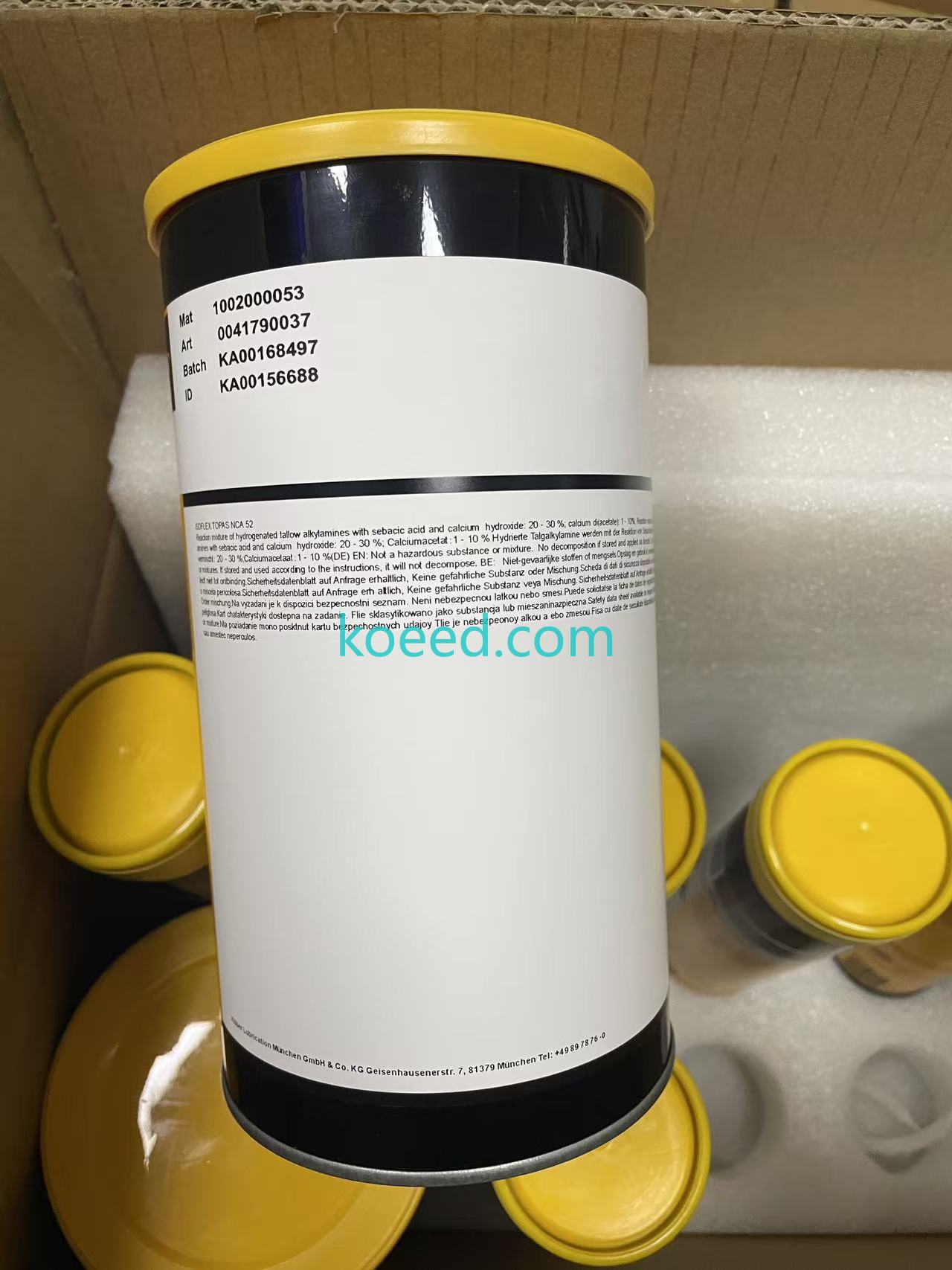
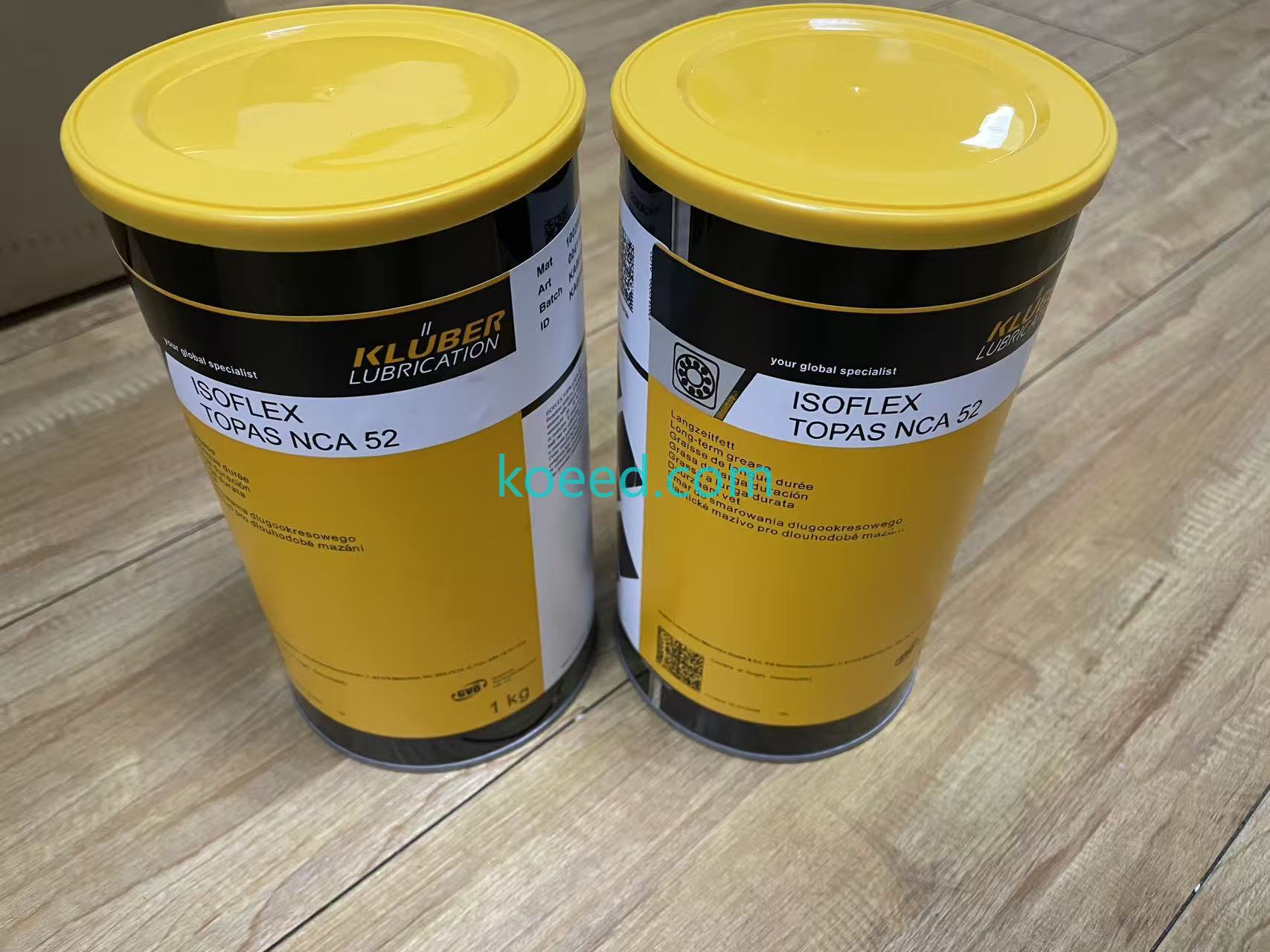
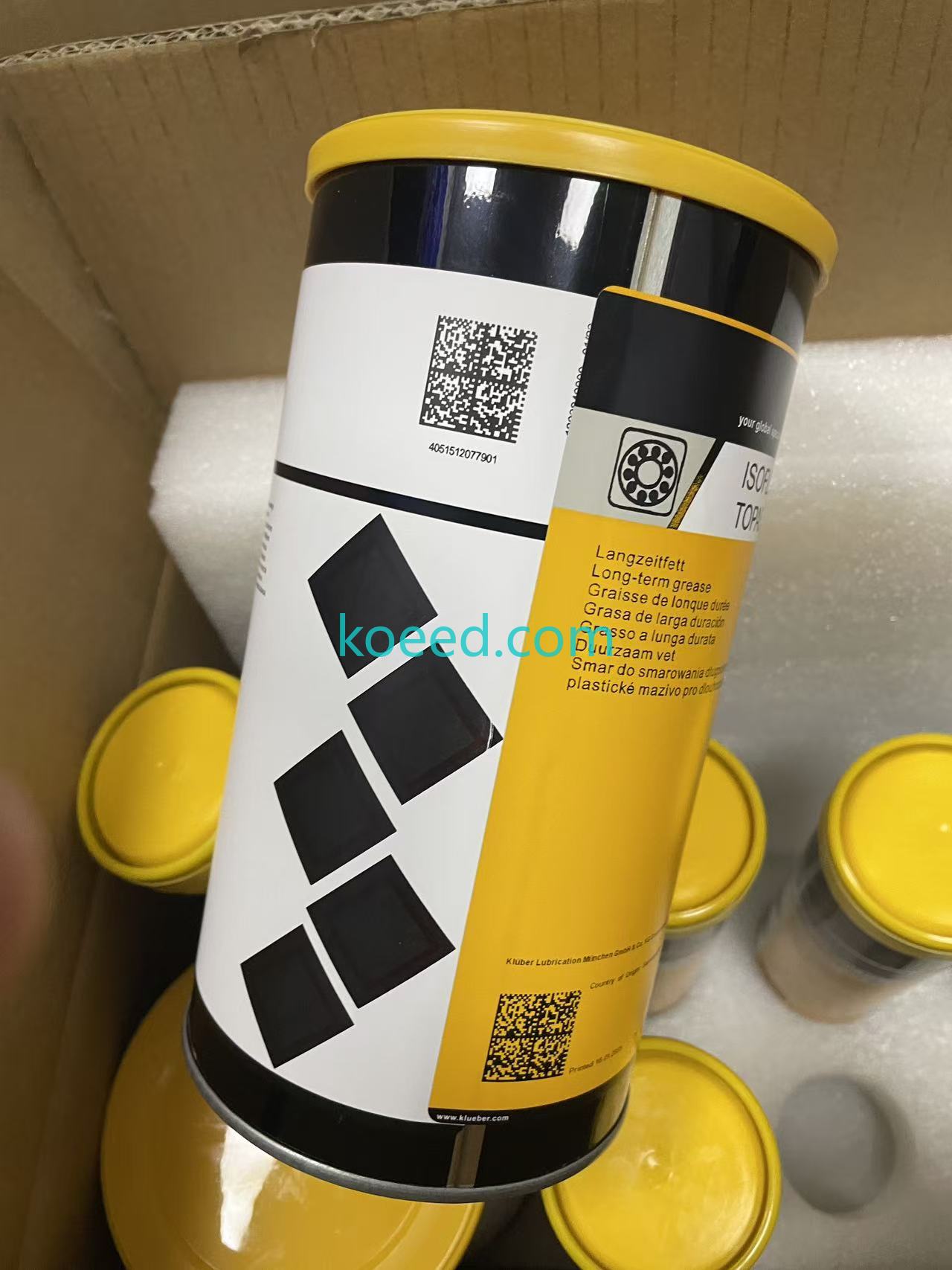
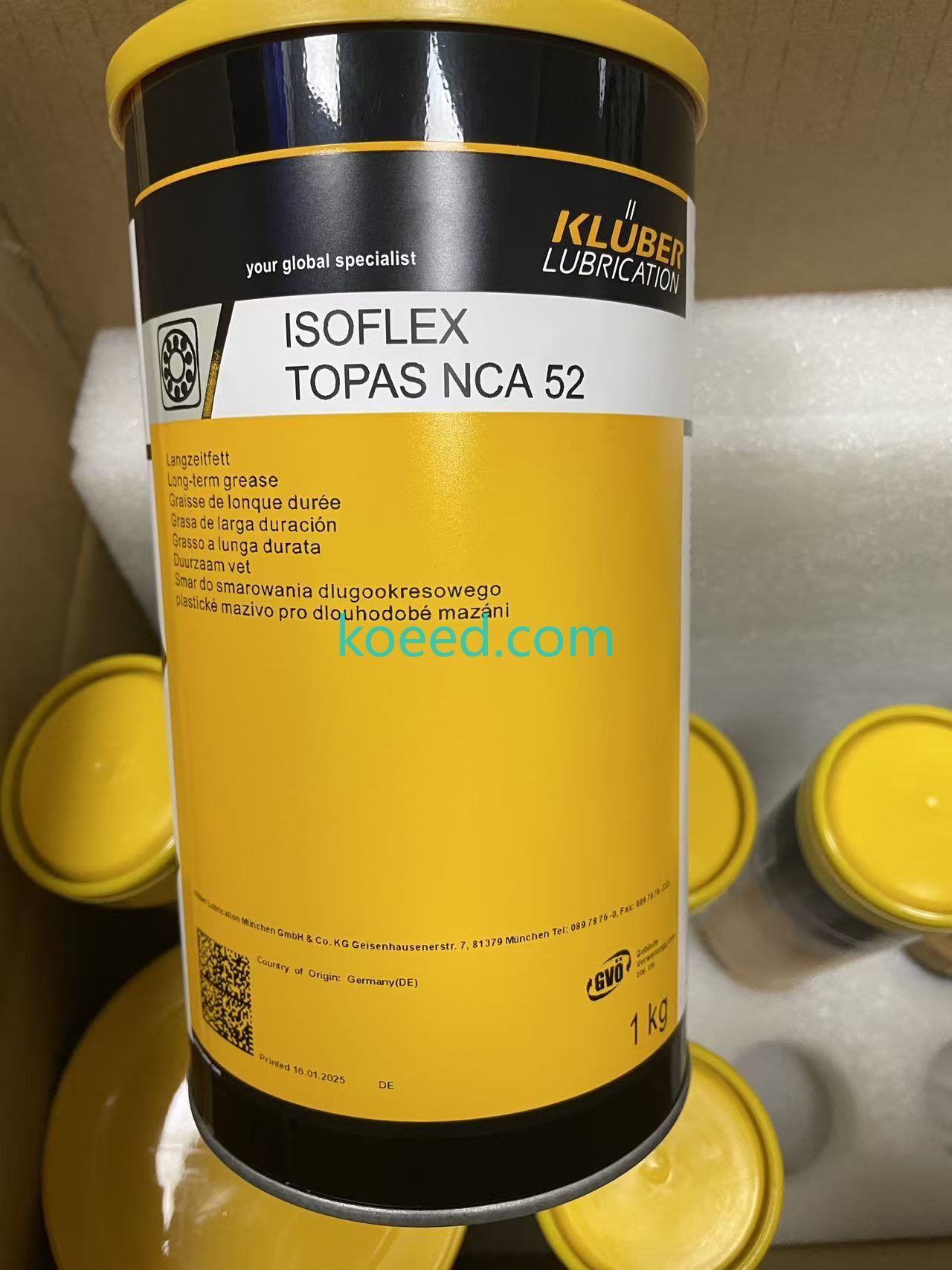
Visual Gallery: ISOFLEX TOPAS NB 5051 & NCA 52
Maintenance & Troubleshooting: Maximizing Grease Longevity
Application Best Practices
Even the finest synthetic grease underperforms if applied incorrectly. Adhere to these 2026-vetted protocols:
- Cleanliness is non-negotiable: Before greasing, purge old lubricant completely. Mixing ISOFLEX TOPAS with residual mineral greases can compromise the thickener structure and reduce service life. Use Kluber's own cleaning fluids where possible.
- Fill volume discipline: For rolling bearings, fill 25–35% of the free bearing volume. Over-greasing is the most common cause of premature bearing failure — excess grease causes churning, heat buildup, and accelerated oxidation.
- Relubrication quantity: Use the formula G = 0.005 × D × B (where D = bearing outer diameter in mm, B = bearing width in mm) to calculate the correct relubrication quantity in grams.
- Temperature monitoring: Track bearing housing temperature trends via your PLC's analog input modules. A sustained 15–20°C rise above baseline often indicates over-greasing or lubricant degradation.
Storage & Shelf Life
Both NB 5051 and NCA 52 have a recommended shelf life of 36 months when stored in original, unopened containers at temperatures between 0°C and +40°C, protected from direct sunlight and moisture. Once opened, consume within 12 months for optimal performance. Always reseal containers immediately after dispensing to prevent contamination.
Frequently Asked Questions
Can ISOFLEX TOPAS NB 5051 and NCA 52 be mixed with other greases?
No. Klüber strongly advises against mixing these synthetic greases with conventional mineral-oil-based greases or greases with different thickener types. Incompatibility can lead to softening, oil separation, or complete thickener collapse. If you must switch from another grease, thoroughly flush the bearing with a compatible cleaning agent and perform an initial fill with the new ISOFLEX TOPAS grade. Koeed technical support can provide compatibility guidance for your specific legacy lubricant.
What is the difference between the 'NB' and 'NCA' designations?
The NB 5051 designation indicates a lower base oil viscosity (NLGI 1), optimized for low-torque, high-speed applications. NCA 52 has a higher base oil viscosity (NLGI 2), providing a thicker lubricant film for higher load-carrying capacity. The 'NCA' prefix generally denotes greases formulated for heavier-duty bearing applications, while 'NB' variants target precision, low-friction mechanisms.
Are these greases suitable for food processing environments?
ISOFLEX TOPAS NB 5051 and NCA 52 are not NSF H1 registered for incidental food contact. For food & beverage automation applications, Koeed recommends Klüber's dedicated food-grade greases such as KLÜBERSYNTH UH1 14 or PARALIQ series. Contact our team for a tailored food-grade lubrication specification.
How do I integrate lubrication schedules into our CMMS/ERP system?
Koeed provides digital specification sheets with structured data fields (bearing type, relubrication interval, grease specification, fill quantity) that can be imported directly into SAP PM, IBM Maximo, Infor EAM, or Fiix CMMS. Ask your Koeed account manager about our CMMS integration package, which includes barcode-labeled cartridges scannable via your maintenance technician's mobile device to auto-log lubrication events.
What lead times can I expect for bulk orders in 2026?
Koeed maintains strategic buffer stock of both NB 5051 and NCA 52 in our global distribution hubs. Standard 370g cartridge orders ship within 24–48 hours. For bulk orders (25kg pails or pallet quantities), lead times are typically 5–10 business days depending on destination. Expedited shipping options are available for critical downtime scenarios — contact our WhatsApp support for real-time inventory verification.
Koeed Value-Added Services for 2026
When you source Klüber ISOFLEX TOPAS greases through Koeed, you gain more than product — you gain an automation lubrication partner:
- Application Engineering Support: Our tribology specialists can review your bearing schedules and recommend the optimal NB 5051 / NCA 52 grade per application point.
- Cross-Reference Service: Migrating from Molykote, SKF, Fuchs, or Shell lubricants? We provide detailed compatibility matrices and transition protocols.
- Consignment Stocking: For high-volume consumers, Koeed offers on-site consignment inventory with usage-based billing — eliminating procurement lead times entirely.
- Condition Monitoring Integration: We partner with vibration analysis and oil debris monitoring vendors to create a closed-loop lubrication health ecosystem tied to your PLC/SCADA architecture.
🚀 Ready to Optimize Your Automation Lubrication Strategy?
Whether you need a single cartridge for a critical spindle or a plant-wide lubrication specification review, Koeed's engineering team is standing by.
Prefer email? Reach our lubrication specialists at support@koeed.com — typical response time: under 4 business hours.


