

E32-TC500 Omron Fiber Optic Sensor: 2026 Guide to Through-Beam Sensing, Oil-Resistant Design & IT/OT Integration
1. Strategic Overview: The E32-TC500 in the 2026 Factory Floor
In an era defined by IT/OT convergence and data-driven manufacturing, the integrity of physical-layer sensing cannot be compromised. The Omron E32-TC500 fiber optic sensor delivers exactly that: a rugged, chemically resilient through-beam fiber unit purpose-built for environments where oil mist, coolant spray, and mechanical stress degrade conventional sensors within months.
By 2026, the industrial automation ecosystem has fully embraced predictive maintenance architectures where edge I/O devices feed real-time telemetry into cloud-based MES/ERP platforms. The E32-TC500 — when paired with modern Omron amplifier units such as the E3NX-FA series — becomes more than a binary presence detector; it transforms into a signal-quality data node capable of reporting light intensity drift, lens contamination alerts, and fiber degradation early warnings that feed directly into CMMS dashboards.
For procurement and engineering teams evaluating total cost of ownership (TCO), the E32-TC500 on Koeed.com represents a strategic investment: its fluororesin-coated sleeve dramatically reduces replacement frequency in harsh wet/oily applications, directly contributing to sustainability KPIs by minimizing electronic waste and unplanned downtime.
2. Technical Benchmarking: Where the E32-TC500 Stands in the E32 Portfolio
The E32 series from Omron is vast, but the TC500 variant occupies a distinct niche: fluororesin-sheathed through-beam sensing for hostile fluid-contact applications. Below is a structured comparison to contextualize its positioning against related fiber units commonly specified in 2026 automation projects.
| Parameter | E32-TC500 (Through-Beam, Coated) | E32-T11N 2M (Standard Through-Beam) | E32-LD11R 2M (Diffuse Reflective) | Legacy Uncoated Fibers (Pre-2020) |
|---|---|---|---|---|
| Sensing Method | Through-Beam (Emitter + Receiver pair) | Through-Beam, M4 cylindrical | Diffuse Reflective | Through-Beam / Reflective |
| Coating | ✔ Fluororesin (PTFE-based), full sleeve | ✘ Standard polyethylene jacket | ✘ Standard polyethylene jacket | ✘ Minimal / no chemical barrier |
| Oil & Coolant Resistance | Excellent — rated for cutting oil, water-soluble coolant | Moderate | Moderate | Poor — jacket swelling within weeks |
| IP Rating | IP67 (with proper installation) | IP67 | IP50 | Varies (IP40–IP65) |
| Bend Radius (Min.) | R1 mm (flexible routing) | R1 mm (flexible) | R25 mm | R10–R25 mm |
| Max Sensing Distance (GIGA Amplifier) | Up to 4,000 mm (through-beam) | 2,000 mm | 840 mm | 1,200–2,000 mm |
| 2026 Smart-Amplifier Compatibility | ✔ E3NX-FA, E3NX-CA (IO-Link enabled) | ✔ E3NX-FA series | ✔ E3NX-FA series | Partial — legacy E3X only |
| Sustainability Index | High — reduced waste, longer lifecycle | Moderate | Moderate | Low — frequent replacement |
3. Visual Inspection Gallery
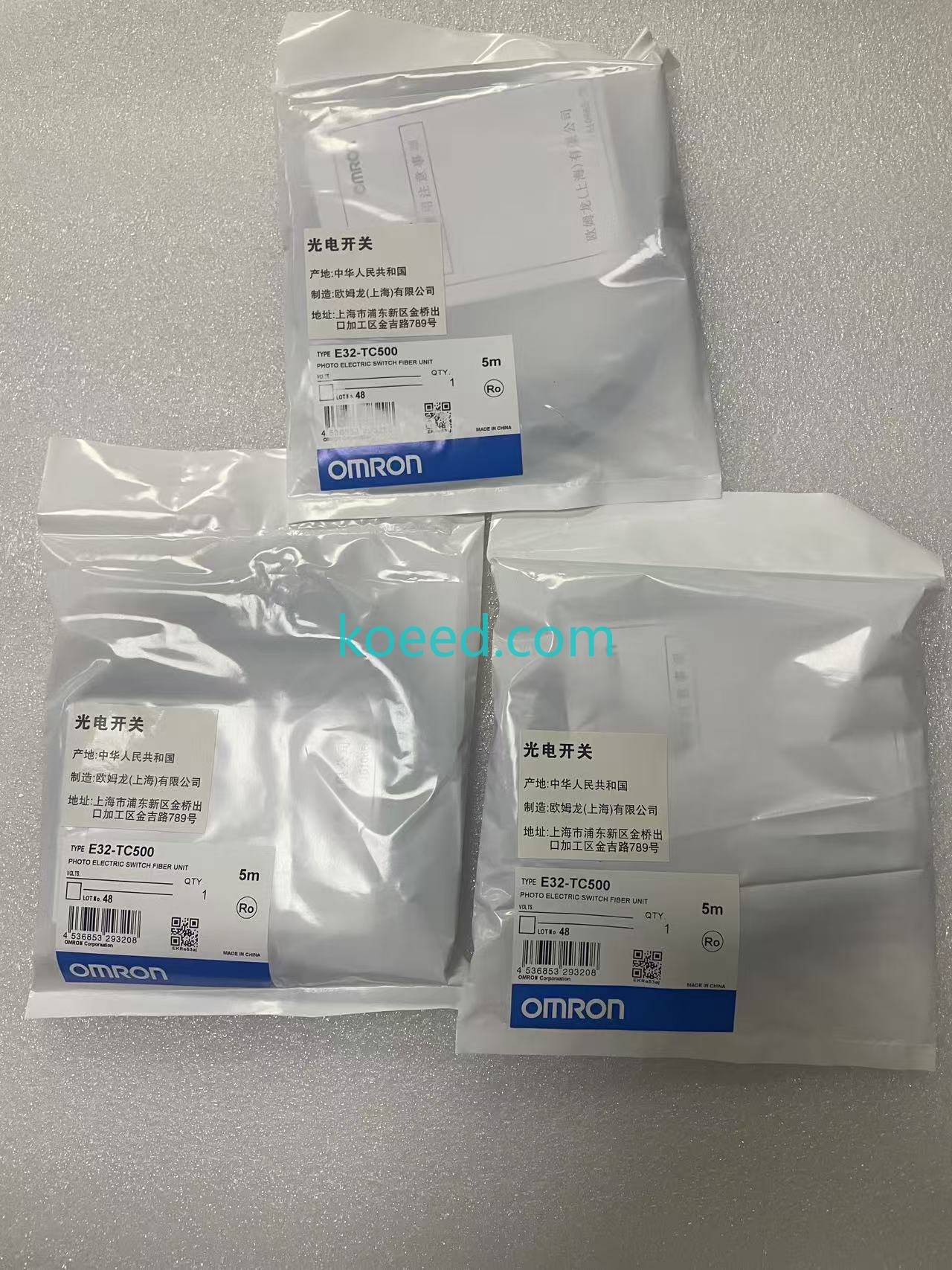
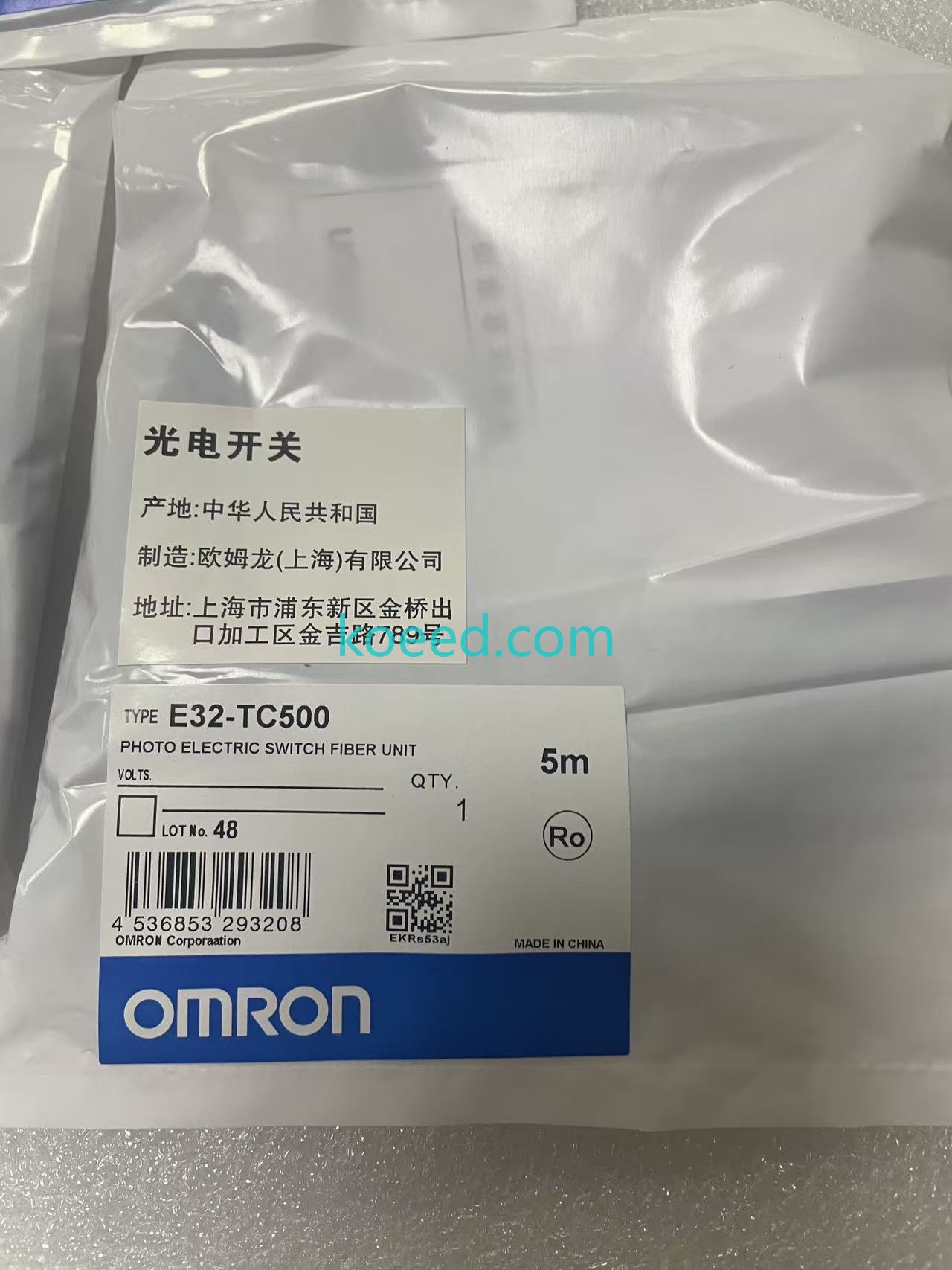
Below are high-resolution photographs of the Omron E32-TC500 fiber sensor. These images showcase the fluororesin-coated sleeve construction, connector interface, and overall build quality — critical visual references for incoming inspection and quality assurance teams.
2.1 IT/OT Convergence: From Discrete I/O to Cloud-Connected Sensing
The 2026 smart factory demands that every sensor contribute to the data lake. The E32-TC500, while a passive optical component, is the physical front-end of a fully digital sensing chain. When coupled with IO-Link-enabled amplifiers, the system delivers:
- Real-time signal strength telemetry streamed via MQTT Sparkplug B to AWS IoT SiteWise or Siemens MindSphere.
- Automatic gain compensation logs for audit trails in pharmaceutical and food & beverage batch tracking.
- Edge-triggered alerts via Node-RED flows when fiber attenuation suggests imminent fouling — enabling condition-based cleaning instead of fixed-interval schedules.
This transforms a simple through-beam presence check into a process health indicator. For system integrators, the E32-TC500 available at Koeed is a drop-in upgrade that requires no mechanical redesign when migrating from legacy E3X amplifiers to the E3NX-FA platform.
4. Maintenance, Troubleshooting & Predictive Care
4.1 Preventive Maintenance Schedule (2026 Best Practice)
Even with fluororesin protection, a disciplined maintenance cadence ensures the E32-TC500 delivers its rated 5+ year service life in aggressive environments.
| Interval | Action | Tool / Method | Acceptance Criteria |
|---|---|---|---|
| Weekly | Visual inspection of sleeve integrity | Flashlight + magnification | No cracks, swelling, or discoloration |
| Monthly | Clean fiber tips (both emitter & receiver) | Isopropyl alcohol (99%) + lint-free wipe | Restored to ≥ 90% of baseline signal strength (verify via amplifier display) |
| Quarterly | Check bend radius compliance along cable route | R-gauge or radius template | No bend tighter than R1 mm |
| Annually | Full signal baseline recalibration | E3NX-FA teaching function | Stable detection margin ≥ 1.5× |
4.2 Common Fault Scenarios & Rapid Resolution
4.3 Predictive Maintenance with IO-Link Telemetry
In 2026, leading plants have eliminated reactive fiber replacement by leveraging light intensity trend data from smart amplifiers. Configure your E3NX-FA to publish received-light-level (%) every 60 seconds via IO-Link. A simple Python script on an edge gateway can calculate the 7-day moving average slope — a negative slope exceeding −2%/day triggers an automated notification to the CMMS to schedule a preventive replacement during the next planned downtime window.
5. Frequently Asked Questions
What amplifiers are compatible with the E32-TC500?
The E32-TC500 is compatible with the full Omron E3NX-FA series (IO-Link-enabled smart amplifiers), the E3NX-CA series, and legacy E3X analog amplifiers. For 2026 greenfield projects, we strongly recommend the E3NX-FA41 2M for native IO-Link and OPC-UA integration. The fiber connector uses the standard Omron 2.2 mm ferrule interface, ensuring backward compatibility across two decades of amplifier generations.
Can the E32-TC500 be used in food & beverage washdown environments?
Yes — with caveats. The IP67 rating and fluororesin coating make it suitable for indirect food contact zones where high-pressure washdown (up to 100 psi, ambient temperature) occurs. However, for direct food contact or CIP (clean-in-place) chemical exposure, consult Omron's EHEDG guidelines. The fluororesin sleeve is resistant to common CIP detergents at ≤60°C but may degrade under prolonged exposure to >5% sodium hypochlorite at elevated temperatures.
What is the actual sensing distance I can expect in a real factory environment?
Real-world sensing distance depends on the amplifier mode selected. With the E3NX-FA in GIGA mode, expect approximately 3,200–4,000 mm in clean air. In environments with light oil mist, derate by ~20% (2,500–3,200 mm). For ST (Standard) mode, expect 1,000–1,500 mm. Always perform an on-site validation with your actual target object — translucent targets (e.g., PET preforms) may require HS (High-Speed) mode with reduced range.
How does fluororesin coating improve TCO compared to standard fibers?
In machining centers using water-soluble coolants, uncoated fibers typically fail within 6–12 months due to jacket swelling and core clouding. The E32-TC500's fluororesin sleeve extends this to 3–5+ years under identical conditions. At an estimated replacement cost of $85–120 per fiber (including labor and downtime), a single avoided replacement pays for the premium within the first year. Over a 5-year asset lifecycle, the cumulative TCO advantage is approximately $340–$480 per sensing point.
Source the Omron E32-TC500 for Your 2026 Automation Project
Koeed stocks genuine Omron E32-TC500 fiber optic sensors with comprehensive traceability, competitive B2B pricing, and global shipping. Whether you need a single unit for a pilot line or volume quantities for a plant-wide retrofit, our procurement team is ready to support your order.


