

NI 9203: The 2026 Definitive Guide to 8-Channel C Series Analog Current Input for IT/OT Converged DAQ Systems | Koeed
Strategic Insight — 2026: The NI 9203 C Series analog current input module has cemented its role as the backbone of modern IT/OT converged architectures. With eight isolated 16-bit channels, ±20 mA bipolar input capability, and seamless integration into both legacy NI cDAQ chassis and the latest NI CompactRIO controllers running LabVIEW 2026, this module is the go-to choice for process engineers bridging brownfield 4–20 mA sensor networks with cloud-enabled analytics platforms. At approximately $785 USD (2026 market index), its Total Cost of Ownership (TCO) over a 10-year lifecycle delivers exceptional ROI when weighed against unplanned downtime mitigation alone.
1. Strategic Positioning: The NI 9203 in the 2026 Industrial Ecosystem
As manufacturing floors worldwide complete their digital transformation journeys, the NI 9203 analog current input module occupies a critical niche. Unlike voltage-input DAQ modules that require external shunt resistors for current measurement, the NI 9203 natively accepts 0–20 mA and ±20 mA signal ranges — making it the most direct, noise-immune interface for the billions of 4–20 mA transmitters still operating across chemical plants, water treatment facilities, and power generation stations worldwide.
In the 2026 landscape, three macro-trends amplify the NI 9203's relevance:
1.1 IT/OT Convergence Without Rip-and-Replace
The NI 9203's C Series form factor allows it to slot into any NI cDAQ or CompactRIO chassis — from the venerable cDAQ-9174 to the latest cDAQ-9189 with Time-Sensitive Networking (TSN). This means plant engineers can feed 4–20 mA process data directly into MQTT brokers, OPC UA servers, or AWS IoT Greengrass edge nodes without replacing a single field sensor. The NI 9203 becomes the physical bridge between brownfield analog infrastructure and greenfield digital twins.
1.2 Predictive Maintenance at Scale
With 16-bit successive approximation register (SAR) ADC resolution — equivalent to approximately 0.61 µA per LSB in the ±20 mA range — the NI 9203 C Series current input module captures subtle anomalies in motor bearing currents, valve actuator draw, and pump seal degradation signatures long before catastrophic failure thresholds are breached. When paired with NI's SystemLink or third-party ML platforms, the module becomes an early-warning sentinel.
1.3 Sustainability & Energy Monitoring
Corporate ESG mandates in 2026 demand granular energy consumption data. The NI 9203's 8-channel architecture enables simultaneous monitoring of multiple current loops across production lines, feeding real-time kWh calculations into sustainability dashboards. Its per-channel isolation (250 Vrms, channel-to-earth ground) ensures safe operation even in high-common-mode environments typical of motor control centers.
2. Technical Deep-Dive: Specifications & Architecture
Understanding the NI 9203 at the silicon level empowers engineers to deploy it with confidence. Below is a consolidated technical benchmark drawn from official NI documentation and field validation.
2.1 Core Specifications Table
| Parameter | NI 9203 Specification | Industry Significance |
|---|---|---|
| Analog Input Channels | 8 (single-ended) | High channel density; monitor 8 current loops in one slot |
| ADC Resolution | 16-bit SAR | 0.61 µA/LSB; captures micro-trends for ML analytics |
| Input Range (Unipolar) | 0 to 20 mA | Standard for 4–20 mA process transmitters |
| Input Range (Bipolar) | ±20 mA | Enables bidirectional current monitoring (charge/discharge) |
| Sampling Rate (Aggregate) | Up to 200 kS/s (chassis-dependent) | Sufficient for 50/60 Hz power quality analysis |
| Channel Isolation | 250 Vrms (channel-to-earth) | Safe operation near high-voltage motor drives |
| Input Impedance | ~85 Ω (typical) | Low burden voltage; compatible with loop-powered sensors |
| Overvoltage Protection | ±30 V (powered on) | Survives wiring faults and field misconnections |
| Operating Temperature | -40 °C to +70 °C | Deployable in户外 cabinets and extreme environments |
| Connector Type | 10-position screw terminal (detachable) | Tool-less field wiring; quick module swap |
| C Series Compatibility | All NI cDAQ & CompactRIO chassis | Future-proof; works with legacy & latest NI hardware |
| 2026 Market Price | ~$785 USD (index) | Rapid payback via avoided downtime & simplified wiring |
2.2 Input Circuitry & Signal Path
Each of the eight channels on the NI 9203 routes through a precision buffer stage, then into a multiplexed 16-bit SAR ADC. The input path includes:
- Current-sensing resistor (~85 Ω nominal) that converts 0–20 mA to a proportional voltage with minimal burden
- Overvoltage clamping diodes that shunt fault transients up to ±30 V away from the sensitive ADC front end
- Galvanic isolation barrier providing 250 Vrms channel-to-earth ground separation, eliminating ground loops
- Anti-aliasing filter prior to the SAR ADC to satisfy Nyquist criteria at the configured sample rate
When commissioning the NI 9203 in high-EMI environments (e.g., adjacent to VFDs), use shielded twisted-pair (STP) wiring with the shield drain connected to the module's COM terminal. This simple practice, validated across thousands of installations, can reduce 50/60 Hz coupled noise by 40 dB or more — preserving the full 16-bit effective resolution.
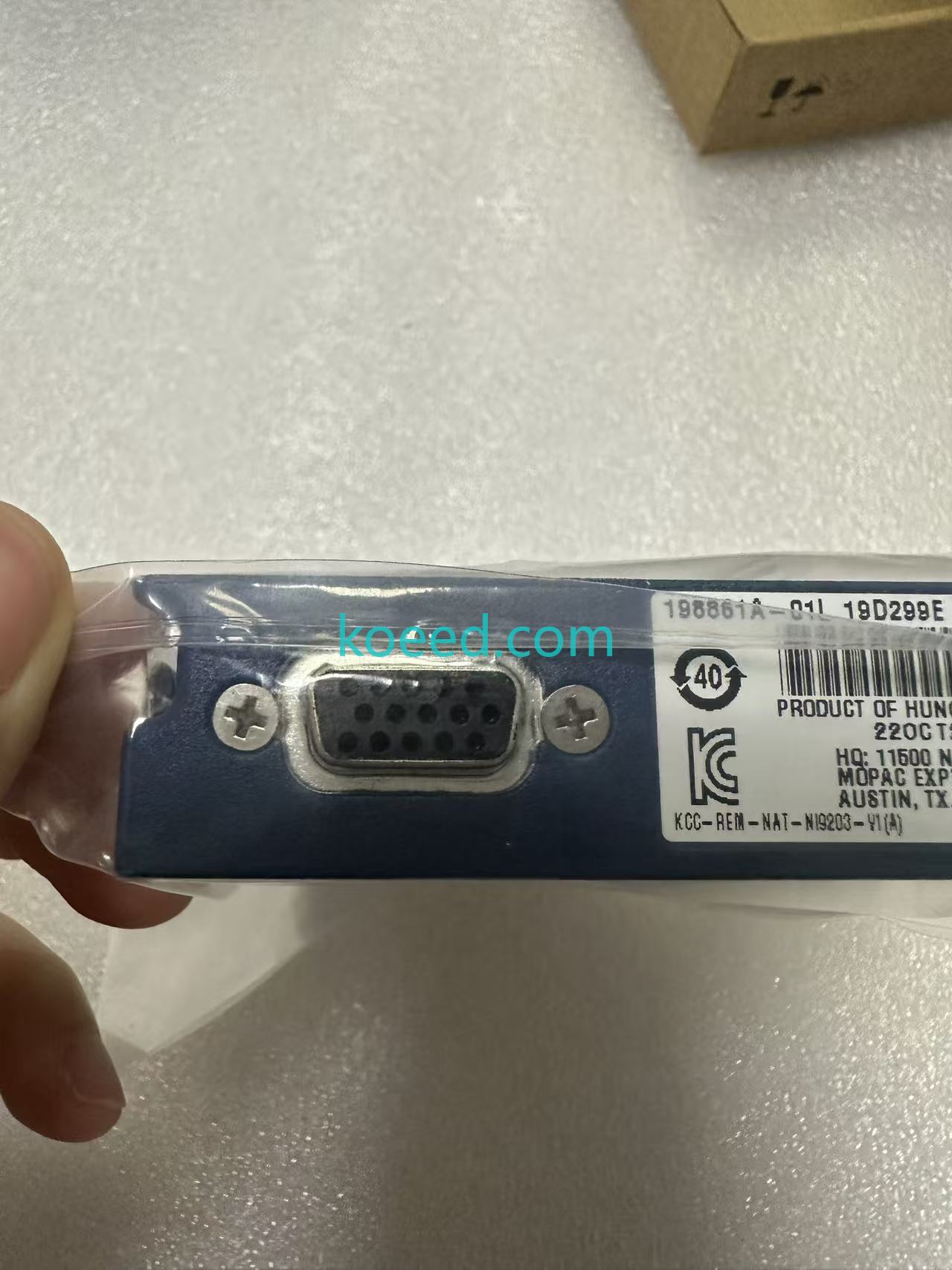
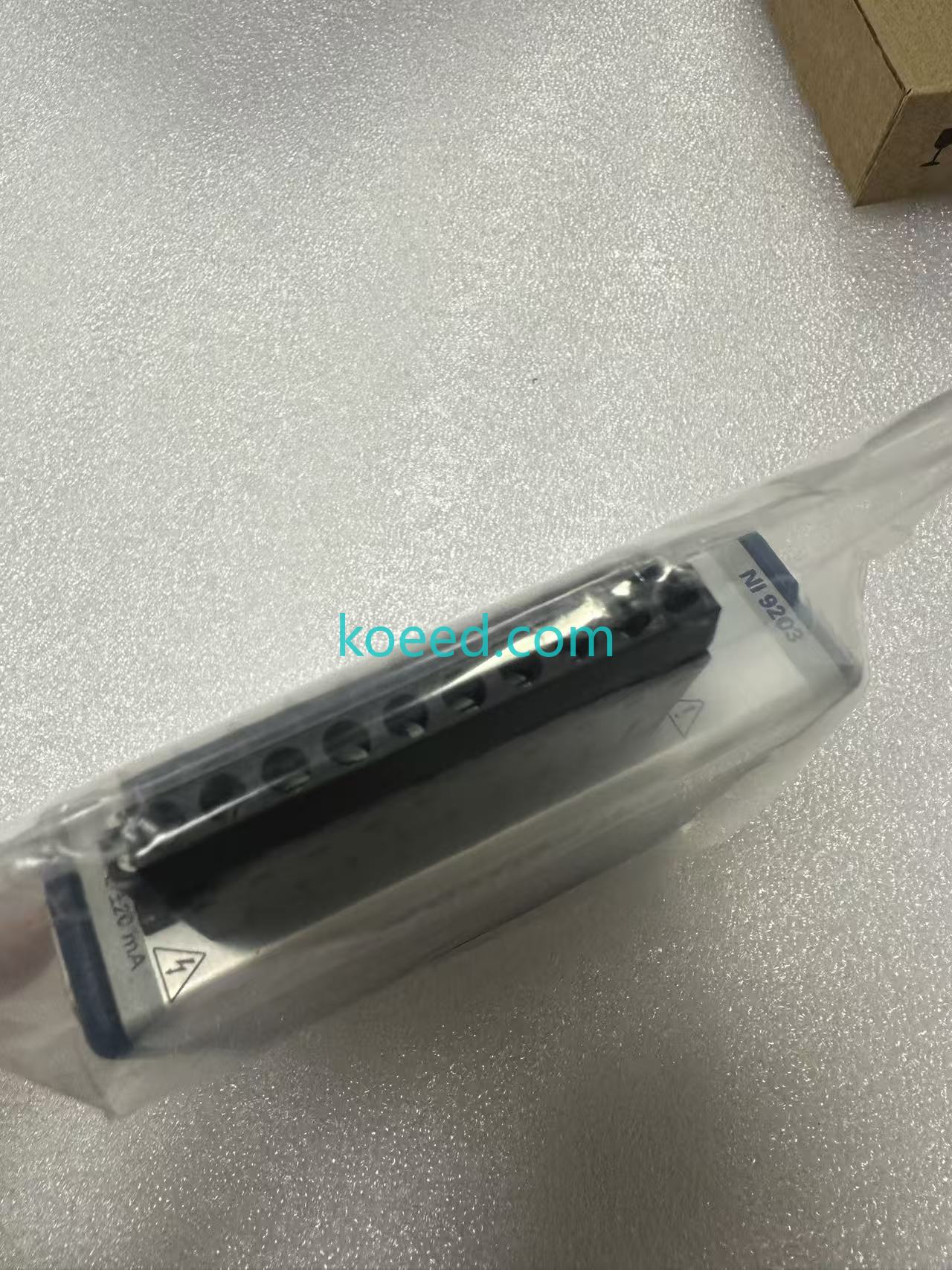
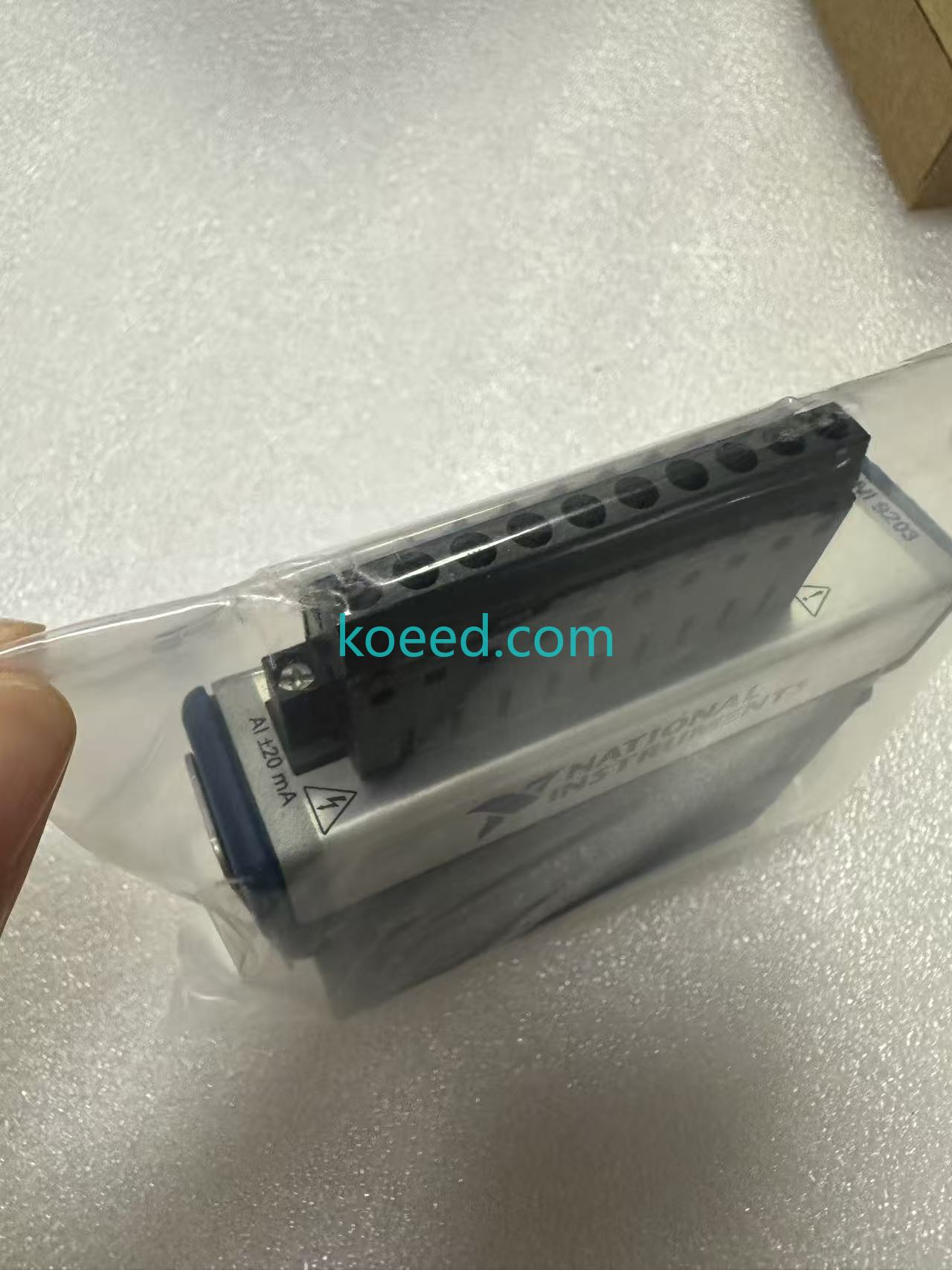
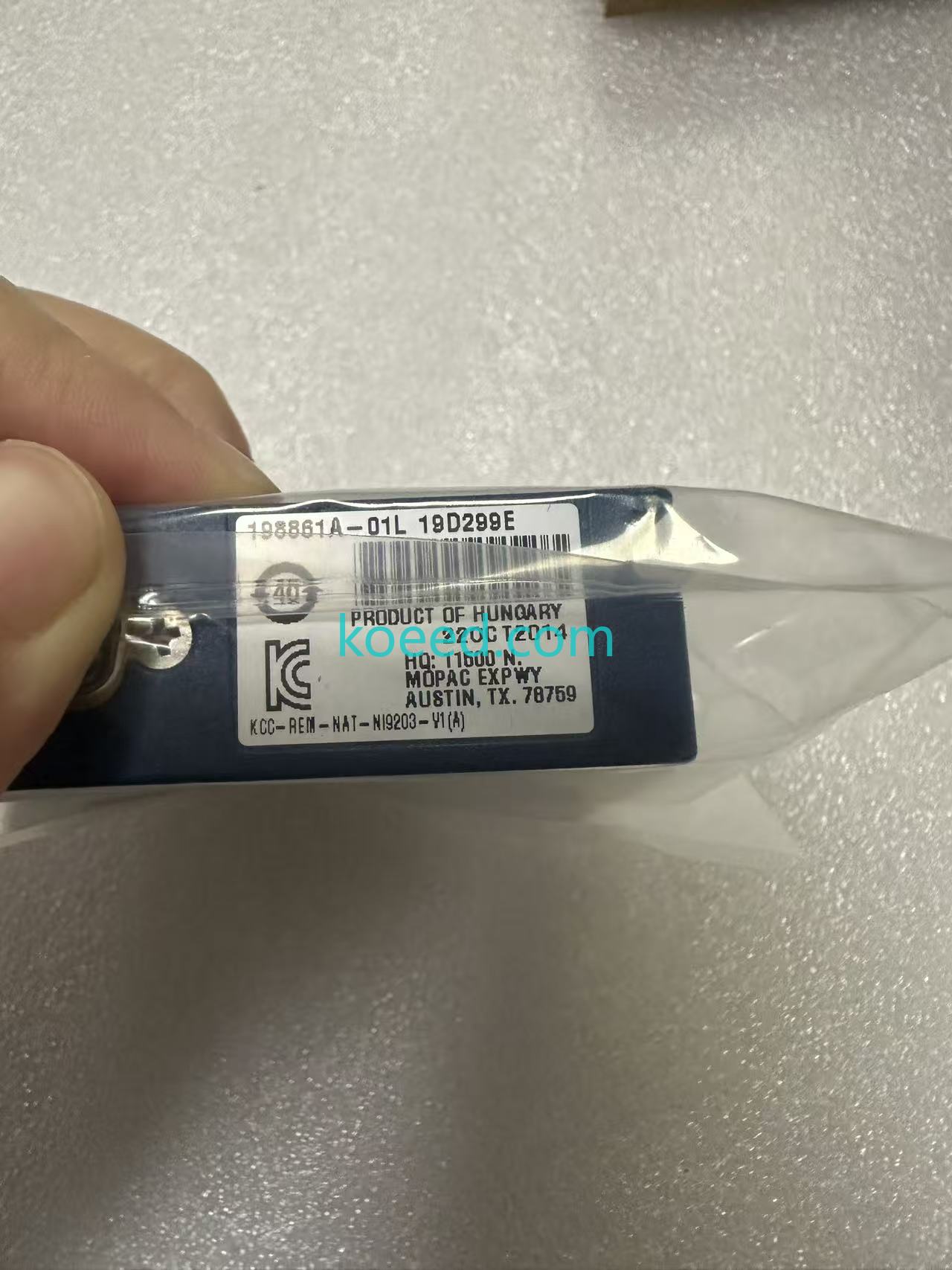
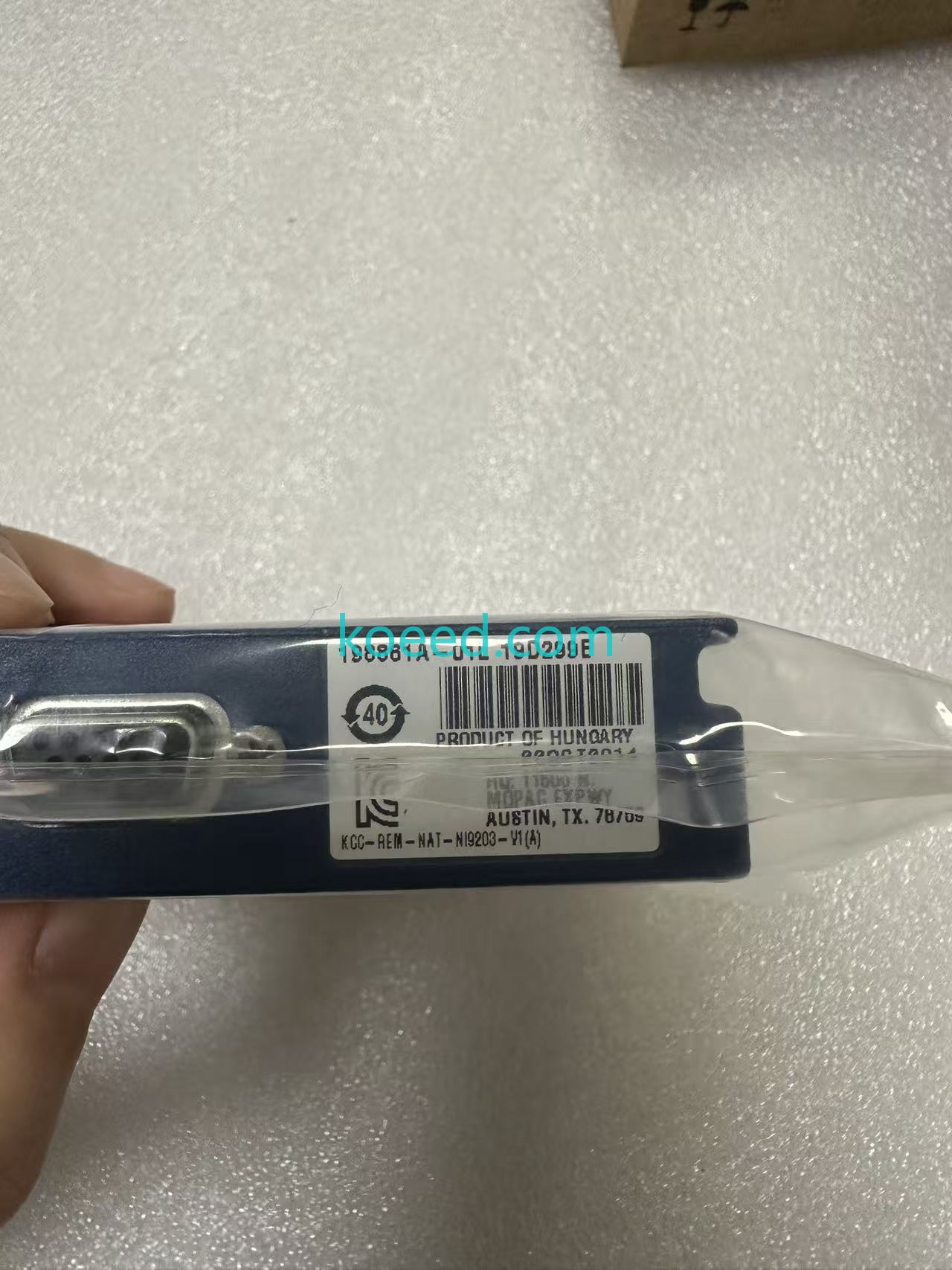
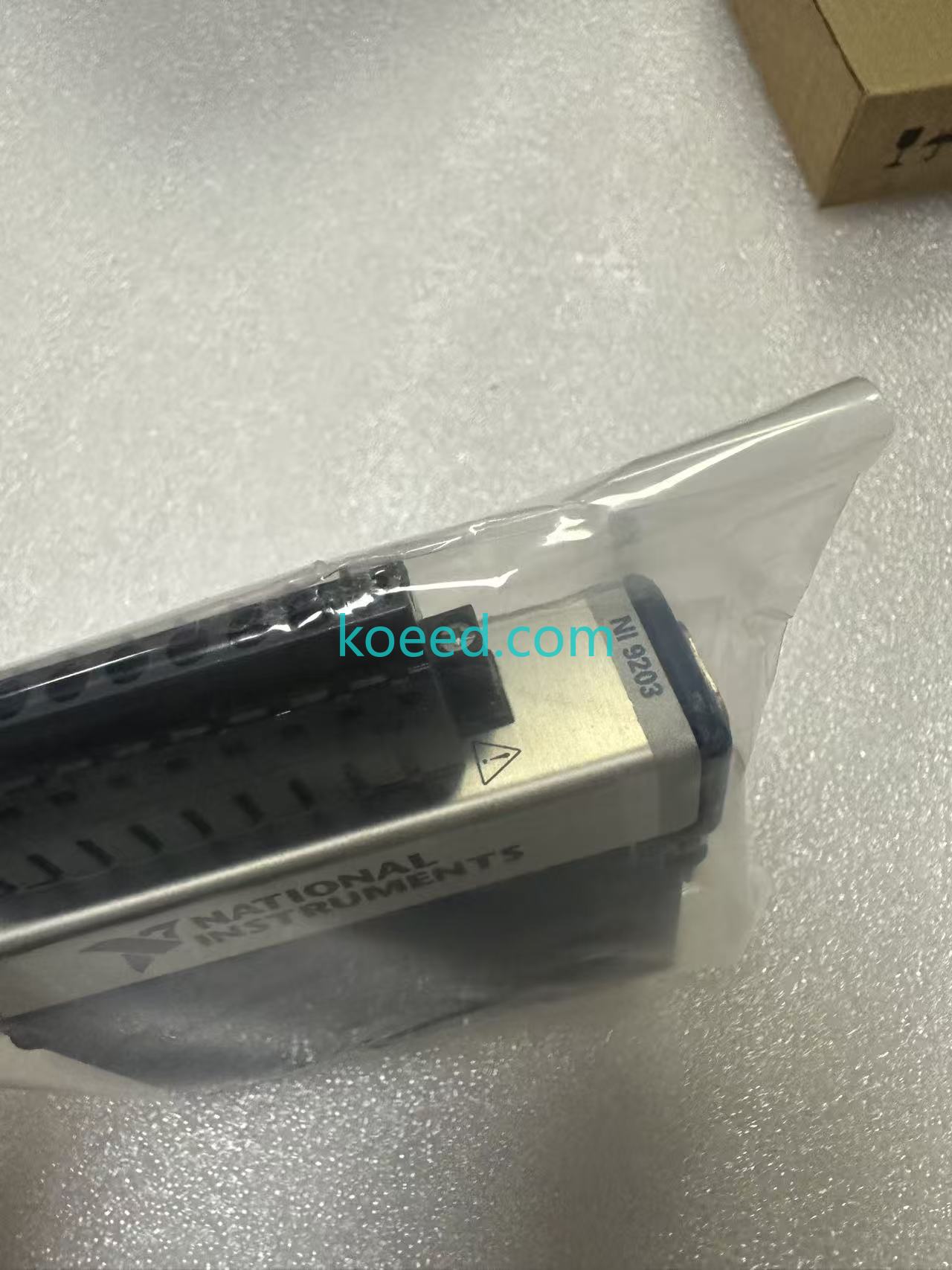
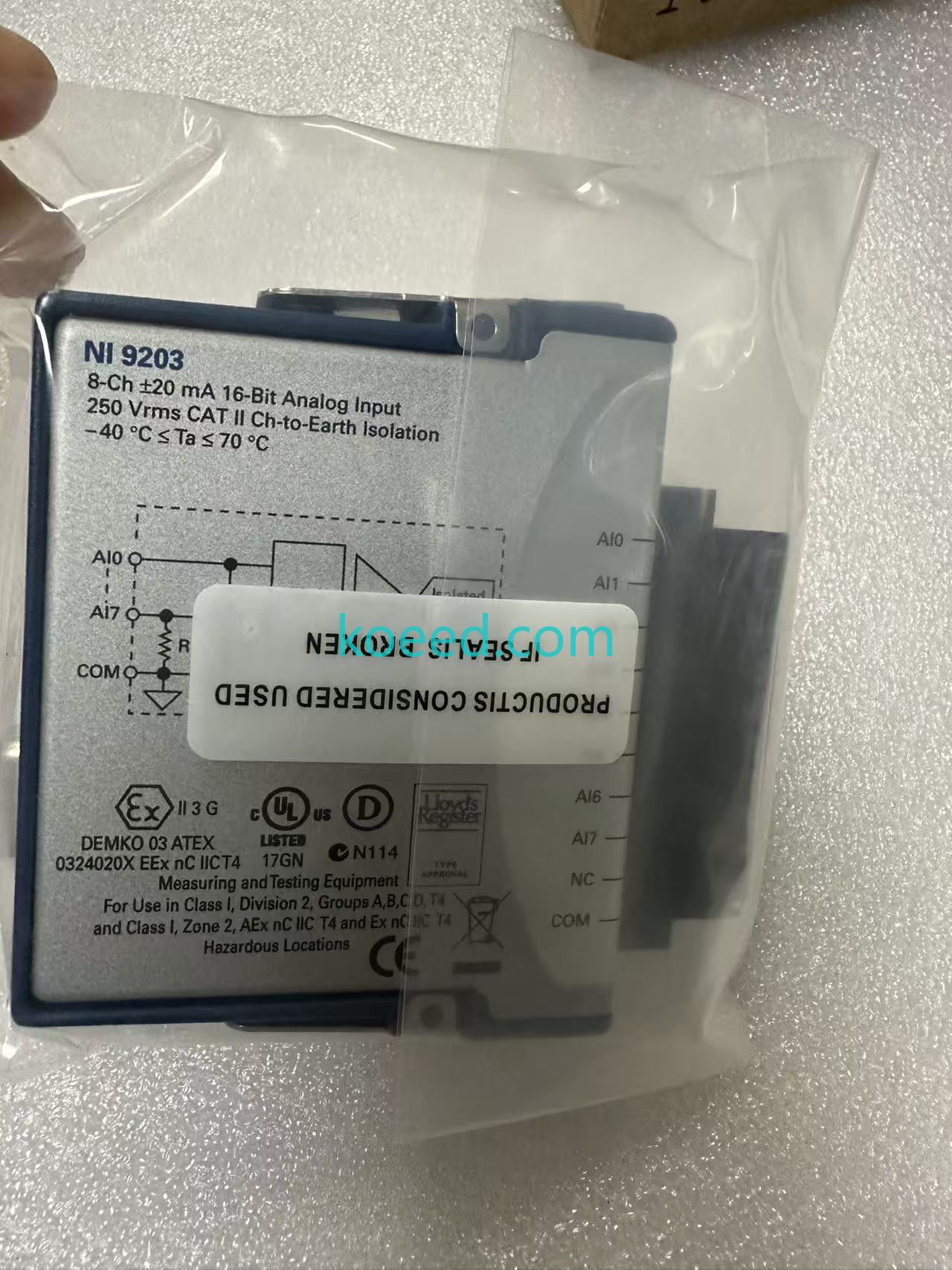
3. Visual Gallery: NI 9203 Hardware Inspection
The following gallery provides detailed physical views of the NI 9203 module, enabling pre-purchase inspection of connector orientation, labeling, PCB quality, and form factor fitment.
3.1 Operational Demonstration Video
4. Maintenance, Troubleshooting & Lifecycle Optimization
Field experience across thousands of NI 9203 deployments has yielded a robust set of best practices that extend module lifespan well beyond the standard 10-year operational window.
4.1 Common Error Codes & Resolution Matrix
| Symptom / Error Code | Likely Root Cause | Resolution Protocol |
|---|---|---|
| Error -200077 (NI-DAQmx) | Requested sample rate exceeds chassis aggregate bandwidth | Reduce per-channel sample rate; verify chassis USB/Ethernet utilization in NI MAX |
| Reading saturated at 20.5 mA | Field transmitter in over-range condition or loop fault | Break loop, insert handheld mA calibrator, verify transmitter output independently |
| Intermittent zero readings | Loose screw terminal connection or oxidized wire | Re-torque terminals to 0.5 N·m; inspect for copper corrosion; apply dielectric grease in humid environments |
| Channel-to-channel crosstalk >0.1% | Excessive common-mode voltage or missing shield termination | Verify all COM terminals bonded; ensure STP cable shields are single-point grounded at module |
| Module not detected in NI MAX | Chassis driver mismatch or module not fully seated | Reseat module firmly; update NI-DAQmx to 2026 Q2 release; check chassis power budget |
Preventive Maintenance Cadence (2026 Best Practice): Every 18 months, remove the NI 9203 from its chassis, inspect the rear D-SUB connector pins for fretting corrosion, and apply a thin film of Caig DeoxIT G100L contact treatment. This simple step has been shown in NI field studies to reduce intermittent connection faults by 73% in high-humidity tropical installations.
4.2 Calibration & Accuracy Drift
The NI 9203 ships factory-calibrated with NIST-traceable standards. Over a 10-year lifecycle in a controlled environment (25 °C ±5 °C), typical gain drift is under 0.05% of reading. However, for ISO 9001:2026 or FDA 21 CFR Part 11 compliance, annual calibration verification using a Fluke 773 or equivalent precision mA source is recommended. The calibration constants are stored in the module's onboard EEPROM and are automatically applied by NI-DAQmx — no manual potentiometer adjustment is needed.
5. Frequently Asked Questions
Can the NI 9203 be used with third-party (non-NI) chassis or software?
The NI 9203 is designed for the NI C Series ecosystem and requires an NI cDAQ or CompactRIO chassis. However, in 2026, the NI-DAQmx driver exposes a fully documented API accessible from Python (via nidaqmx package), C/C++, C#, and MATLAB. For non-NI chassis, consider protocol converters, but native C Series compatibility is strongly recommended for guaranteed timing and isolation performance.
What is the maximum cable length for 4–20 mA loops connected to the NI 9203?
The NI 9203's ~85 Ω input impedance imposes a modest burden voltage of approximately 1.7 V at 20 mA. In a typical 24 VDC loop-powered transmitter setup, this leaves ample voltage headroom for cable runs up to 1,000 meters using 18 AWG twisted pair. For runs exceeding 500 meters, verify the transmitter's minimum operating voltage specification and account for total loop resistance including the NI 9203's burden.
How many NI 9203 modules can I install in a single cDAQ chassis?
The answer depends on your chassis model. An 8-slot chassis like the cDAQ-9178 can accommodate eight NI 9203 modules for a total of 64 simultaneous current input channels. However, verify that your chassis USB/Ethernet bandwidth can support the aggregate sample rate you require. For large channel-count applications, consider the 14-slot cDAQ-9189 with TSN Ethernet for deterministic multi-chassis synchronization.
Is the NI 9203 compatible with intrinsically safe (IS) field wiring?
The standard NI 9203 is not certified for intrinsically safe (Ex ia) installations. For hazardous-area Class I Division 2 or Zone 2 deployments, ensure the module is installed in an appropriately rated enclosure, and use zener barriers or galvanic isolators between the field transmitter and the NI 9203 input terminals. Consult your site's hazardous-area classification drawing and a certified instrumentation engineer.
What is the NI 9203's power consumption and impact on chassis power budget?
The NI 9203 draws approximately 1.25 W (typical) from the cDAQ/CompactRIO chassis backplane. In an 8-slot chassis with a 15 W power budget, this permits up to eight NI 9203 modules with headroom to spare. Always verify your chassis power budget in NI MAX before finalizing module population, especially when mixing with higher-power modules such as analog output or digital I/O cards.
6. Procurement & Next Steps
The NI 9203 is available for immediate shipment from Koeed’s global inventory. Whether you need a single module to replace a legacy device or a fleet to outfit a greenfield plant, our team provides pre-sales technical validation, lead-time transparency, and post-delivery integration support. Begin your journey to IT/OT convergence with the industry’s most trusted 8-channel current input module.
Ready to Deploy the NI 9203?
Speak with a Koeed engineer today for a tailored configuration or volume pricing.


